Light, Vitamin D, and Human Health
A synthesis of the published research on vitamin D biology, sunlight's full-spectrum effects, photobiomodulation, circadian photoreception, mitochondrial health, the gut microbiome, and outdoor exposure. Compiled July 2026 · revised edition 30 July 2026 · roughly 19,000 words.
How to read this#
This is a long, citation-dense document, and it is deliberately not written as advice. Three things are worth knowing before you start.
It grades itself. The literature on light and health ranges from settled textbook biology to single mouse studies, and flattening that range is how wellness content goes wrong. Every substantive claim here carries an evidence tier, and the two summary tables (Section 9.3 and Section 12.9) exist so you can see the whole distribution at once. The tiers:
| Tier | What it means | Typical basis |
|---|---|---|
| A — Established | Randomized trials, or meta-analyses of trials, show the effect; or the mechanism is textbook biology | VITAL's autoimmune result; the myopia school trials; melatonin suppression by evening light |
| B — Strong but not proven | Consistent observational or genetic (Mendelian-randomization) evidence, no definitive trial | Sun avoidance and mortality; low vitamin D and dementia; preterm birth |
| C — Preliminary or mixed | Small, single-lineage, or conflicting human data | Gut microbiome shifts; fibromyalgia pain; COVID-19 supplementation |
| E — Expert position | A named researcher's stated belief that runs ahead of the trials | Section 14, in full |
Where it is contested, it says so. Optimal vitamin D levels and sun-exposure guidance are live scientific arguments, not solved questions. Sections 2, 4.2, 10.3 and 14 present the competing positions side by side rather than picking a winner. Section 14.4 states the sceptical case — that low vitamin D may be largely a marker of ill health rather than a cause — at full strength, because a reader who cannot state that argument has not understood the field.
It is not medical advice. Nothing here is a diagnosis, a treatment plan, or a dose recommendation for you specifically. OPSIN is a general wellness and lifestyle tracker, not a medical device. Vitamin D dosing, sun exposure, and light-therapy decisions belong with a clinician who knows your history, medications, skin type, and risk factors — see the full disclaimer at the end, and our Medical Disclaimer.
Sources are numbered footnotes throughout, and every number resolves to the publication that reports it — not to coverage of it. Section 16.2 states the three rules we hold citations to, including how we handle quotes and how corrections get published.
Executive Summary#
The premise behind OPSIN — that getting people outdoors into daylight is profoundly health-promoting — is supported by a large and rapidly maturing body of evidence, and the science goes considerably deeper than "sunlight makes vitamin D."
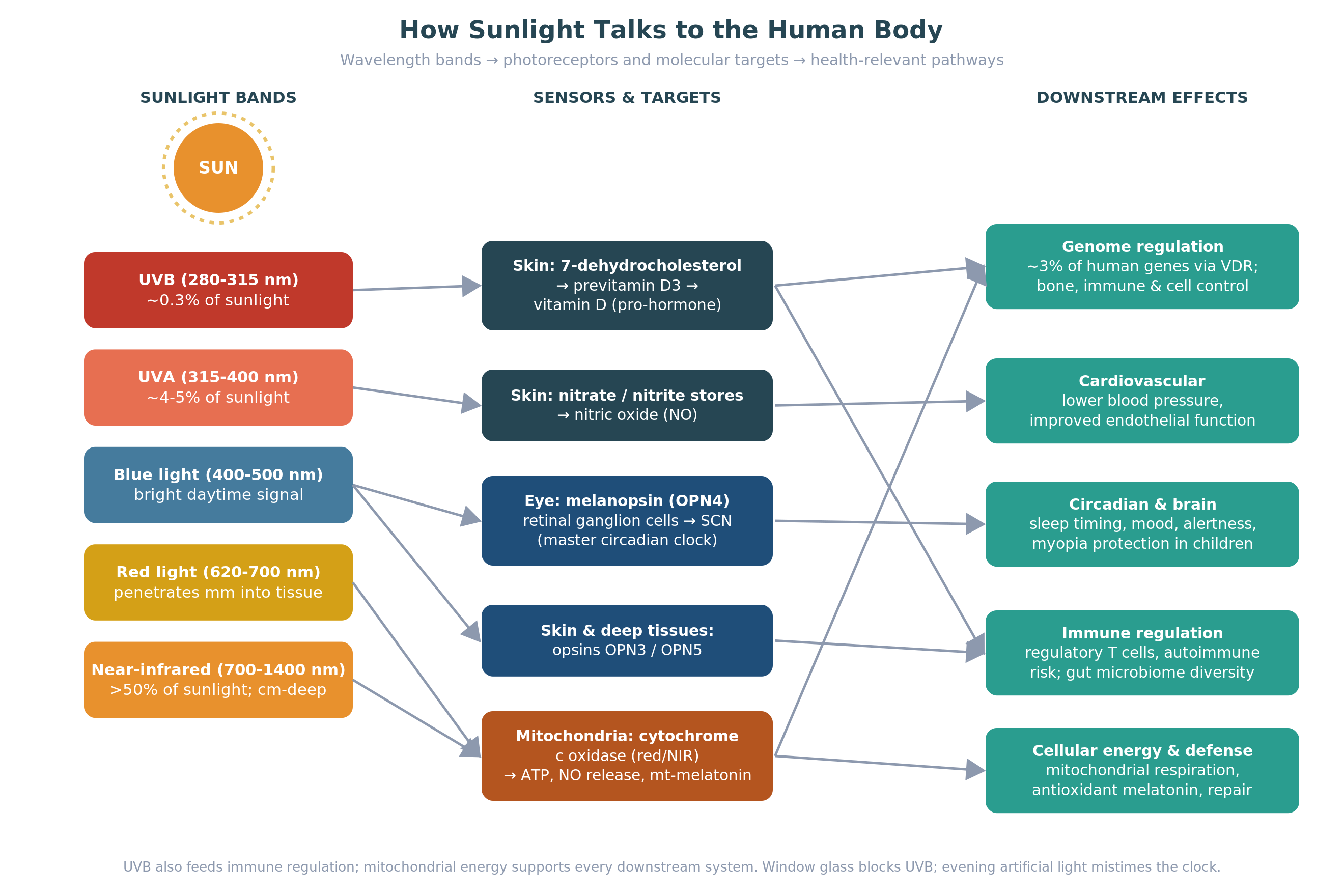
Vitamin D is not a vitamin. It is a secosteroid pro-hormone. Its active form binds the vitamin D receptor (VDR), a nuclear receptor expressed in nearly every human cell type, and modulates the transcription of more than 900 genes — roughly 3% of the human genomePMC. This is why vitamin D biology touches bone, immunity, metabolism, muscle, brain, and gut simultaneously, and why framing it as a mere dietary "vitamin" understates its role by orders of magnitude.
The official intake targets are genuinely contested. The U.S. Institute of Medicine's 600 IU/day recommendation rests on a statistical interpretation that two independent re-analyses showed to be wrong: correctly calculated, achieving even the IOM's own 20 ng/mL threshold in 97.5% of the population requires on the order of 7,000–8,900 IU/day from all sources — roughly an order of magnitude more than the published RDAPMCPMC. Meanwhile, the Endocrine Society swung from targeting 30 ng/mL (2011) to abandoning universal targets altogether (2024), a guideline that remains openly controversialPubMedFrontiers.
The number on a blood test is not the vitamin D your cells see. About 85–90% of circulating 25(OH)D is tightly bound to vitamin D binding protein (DBP), less than 0.1% circulates freely, and for many tissues it is the free or "bioavailable" fraction (~10%) that crosses membranes and feeds local hormone productionPMCPMC. Immune cells respond to free 25(OH)D, not the DBP-bound total. The distinction between blood vitamin D and cellular vitamin D is therefore real, not a technicality.
Vitamin D status directly modulates mitochondria. Correcting severe deficiency improved muscle mitochondrial oxidative efficiency in a small open-label human case series — phosphocreatine recovery half-time 34.4 → 27.8 s; Grade B, no placebo armPubMed — while three months of induced deficiency cut mitochondrial respiration by 35–37% in animal muscle (preclinical evidence)PubMed. Red and near-infrared light — which make up more than half of sunlight's energyScienceDirect — act on mitochondria independently through cytochrome c oxidase, boosting ATP and, in a small human trial, blunting post-meal glucose spikes by 27.7% after 15 minutes of 670 nm exposure — Grade C, a single unreplicated studyPubMed. Near-infrared light also appears to drive melatonin synthesis inside mitochondria themselves, a local antioxidant system distinct from the pineal "sleep hormone"PMC.
Sunlight acts far beyond vitamin D. UVA releases nitric oxide from skin stores, measurably lowering blood pressure independent of vitamin DPubMed. UV exposure induces regulatory T cells and systemic immune tolerance — a mechanism that even mimics the drug fingolimod used against multiple sclerosisPubMedPubMed. In a 20-year cohort of 29,518 Swedish women, avoiding the sun was associated with double the all-cause mortality of the highest-exposure group, a risk magnitude comparable to smoking — Grade B: a single observational cohort in which healthier, more active people may simply spend more time outdoors, so causality is unproven (the sceptical reading is presented in §14.4)PubMedPubMed. Light hitting the gut–skin axis reshapes the microbiome within a weekFrontiers, and simply adding 40 minutes of outdoor time to the school day cuts incident childhood myopia by roughly a fifth to a quarter in relative terms — Grade A, school-based randomized trialsPubMedPubMed.
The following report develops each of these threads in depth, with the underlying evidence, the genuine controversies, and practical synthesis — structured so that individual sections can be adapted directly into OPSIN knowledge-base articles.
Expanded edition note (July 2026): This second edition adds five new sections (11–15) that extend the report well beyond the original brief. They quantify the global scale of the deficiency problem (roughly half of humanity below the IOM's own sufficiency threshold and over three-quarters below the Endocrine Society floorPubMed); map low vitamin D and low light exposure system-by-system across dozens of conditions — falls and fractures, respiratory infections and COVID-19, cancer mortality, diabetes, dementia, depression, inflammatory bowel disease, chronic pain, and preterm birth — with an honest evidence grade for each; add three major light-specific domains not previously covered (bright-light therapy for depression, the WHO's classification of night-shift work as a probable carcinogen, and the skin's newly discovered UV-driven endorphin reward system); and close with a clearly labeled tour of positions held by the field's most notable researchers, distinguished from trial-proven fact.
1. Vitamin D: The Hormone Misnamed a Vitamin#
1.1 A naming accident with real consequences#
Vitamin D acquired its name in the early 1920s, when researchers alphabetized the newly discovered food factors and slotted the anti-rickets factor in after vitamins A, B, and C. The name stuck, but the biology never matched it. A vitamin, by definition, is an organic compound that must come from the diet because the body cannot make it. Vitamin D fails that definition outright: human skin synthesizes it from cholesterol when ultraviolet B photons strike the epidermis, and what the skin (or diet) delivers is not the active molecule at all but a precursor that the liver and kidneys — and, critically, dozens of other tissues — convert into a potent signaling hormone. Modern reviews state this plainly: despite the name, vitamin D "is truly a pro-hormone, with complex endocrine regulation"PMC. The endocrine community has long treated its final active form, calcitriol (1,25-dihydroxyvitamin D), exactly like other steroid hormones such as cortisol, estrogen, and testosterone — all of which, notably, are also built from cholesterol.
The "vitamin" framing has had practical consequences for public health. Because vitamins are conventionally dosed in small, deficiency-preventing quantities, vitamin D recommendations were set at the level needed to prevent rickets — a bone disease — rather than at the level a hormone system might require for full function across the many tissues that use it. And because vitamins are presumed to act uniformly once ingested, the subtleties of sunlight-driven synthesis, tissue-level activation, and individual variation in binding proteins were treated as footnotes for decades. The research reviewed in this report suggests all three of those simplifications are now untenable.
1.2 The vitamin D receptor: a master switch wired into 3% of the genome#
The strongest evidence that vitamin D is a hormone comes from its receptor. The vitamin D receptor (VDR) is a member of the nuclear receptor superfamily — the same protein family as the receptors for thyroid hormone, sex steroids, and glucocorticoids. When calcitriol binds the VDR, the complex partners with the retinoid X receptor, docks onto vitamin D response elements in DNA, and switches genes on or off. VDRs are expressed in almost every type of human cell — intestine and bone, but also muscle, immune cells, brain, skin, and pancreas — and they modulate the transcription of more than 900 genes, approximately 3% of the human genomePMC. That genomic footprint explains why vitamin D status keeps surfacing in studies of conditions with no obvious connection to bone: immune modulation, cardiovascular disease, metabolic syndrome, and cancer among themPMC.
There is also a second, faster layer of signaling. Beyond the hours-long genomic pathway, vitamin D acts through membrane-associated rapid-response signaling, and the vitamin D–metabolizing enzymes themselves (including 1α-hydroxylase, which creates the active hormone) sit inside mitochondria — a detail that becomes important in Section 3. Furthermore, the machinery is distributed: many tissues express their own 1α-hydroxylase and convert circulating 25(OH)D into active calcitriol locally, for their own use, without exporting it to the bloodstream. This intracrine system — hormone made and consumed inside the same cell — is how immune cells, for example, use vitamin D to produce antimicrobial peptides, and it means the endocrine (blood-borne) level of active calcitriol tells us little about what individual tissues are doingPMC. Vitamin D thus operates simultaneously as an endocrine hormone (kidney-made calcitriol managing calcium), a paracrine signal (between neighboring cells), and an intracrine one (within single cells) — a triple identity no ordinary vitamin possesses.
1.3 Why this reframing matters#
The hormone framing is not pedantry — it changes three practical intuitions. First, dose: hormones are titrated to physiological ranges, and the question "how much is enough" becomes an endocrinology question rather than a nutrition-label question, which is precisely the scientific controversy examined in Section 2. Second, source: the body evolved to manufacture this hormone from sunlight, with dietary intake as a backup channel, so the default state of human biology is sun-derived production and the pill is the approximation — a point that matters when interpreting why supplement trials underwhelm (Section 9). Third, measurement: hormone systems are governed by transport proteins, receptor density, and local conversion, so a single blood number cannot capture tissue-level status — the subject of Section 2.4.
It is equally important to present this reframing responsibly. Claiming "vitamin D is a hormone, so more must be better" would be a non-sequitur; hormones have optimal ranges, feedback regulation, and genuine toxicity at extreme doses. The intellectually honest position — and the one the evidence supports — is that vitamin D should be evaluated with the rigor we apply to other hormones: with attention to free versus bound fractions, tissue-level activation, individual variation, and physiological rather than deficiency-preventing targets. That is the standard this report applies throughout.
2. The Great Vitamin D Level Debate#
2.1 How the official numbers were set — and how far apart they are#
For the past fifteen years, authoritative bodies have issued strikingly different answers to the seemingly simple question "what vitamin D level is healthy?" The U.S. Institute of Medicine (IOM, now the National Academy of Medicine) set its 2011 dietary reference intakes around a serum 25(OH)D target of 20 ng/mL (50 nmol/L), with an RDA of 600 IU/day for most adults, judging the evidence for non-skeletal benefits too inconsistent to justify more. The Endocrine Society's 2011 guideline, written from a clinical endocrinology perspective, declared deficiency below 20 ng/mL, insufficiency at 21–29 ng/mL, and sufficiency at 30–100 ng/mL, with many of its authors favoring 40–60 ng/mL as the optimal band. The UK's SACN settled even lower, at a protective threshold of 10 ng/mL (25 nmol/L) for population bone health. A Japanese expert panel landed near the Endocrine Society. GrassrootsHealth's consortium of vitamin D scientists issued a call to action centered on 40–60 ng/mL — a range Heaney's dose-response analysis showed requires roughly 9,100 IU/day of supplemental input to guarantee for 97.5% of a cohortPMC.
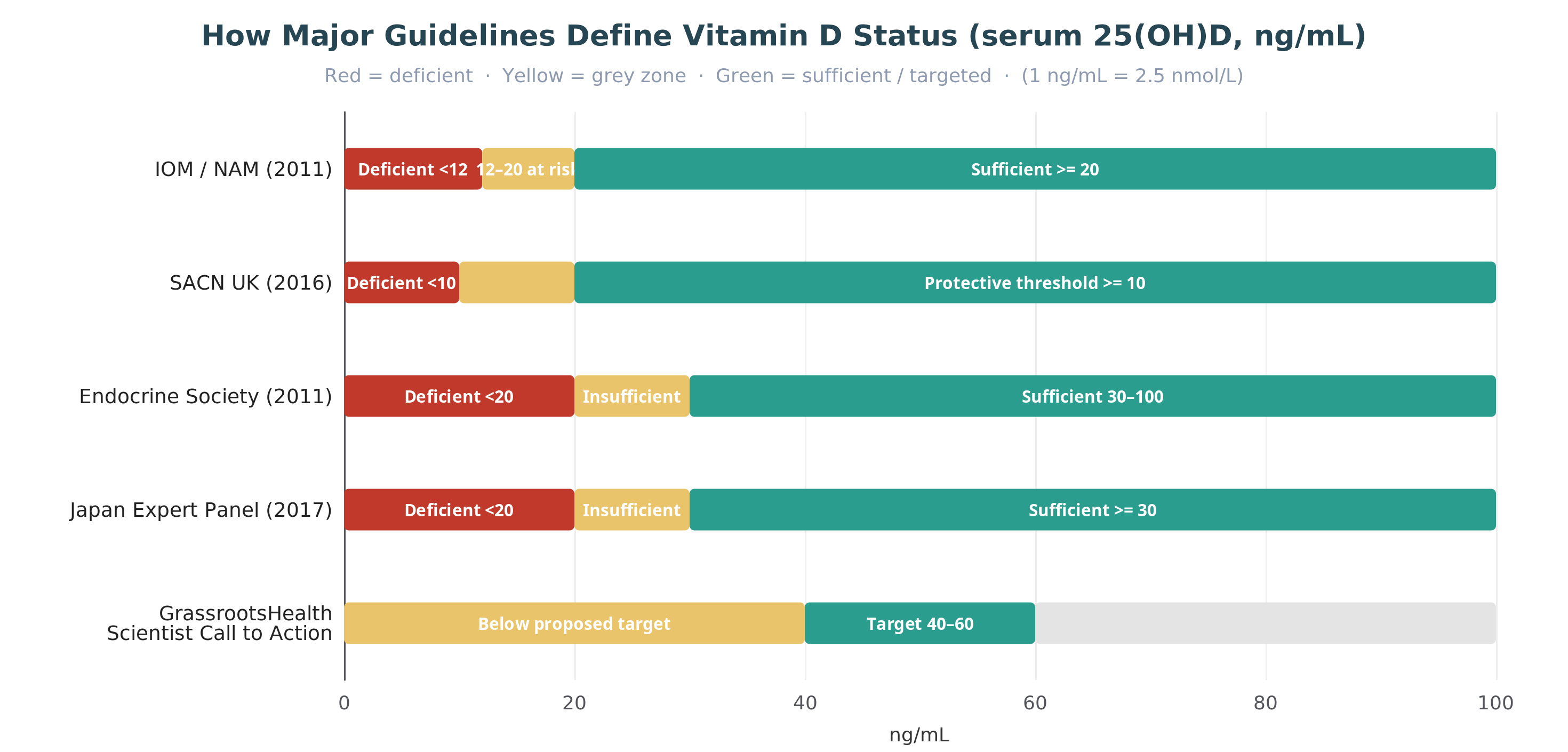
These are not minor disagreements at the margin. The difference between "20 ng/mL is fine" and "40–60 ng/mL is optimal" is the difference between declaring most of the world's population adequately supplied and declaring most of it chronically undersupplied. More than half of the world's population falls below 20 ng/mL by the stricter definitions, especially in winterFrontiers. The spread among guidelines reflects a genuine evidentiary problem — the non-skeletal outcomes that would discriminate between targets rest largely on observational data — but it also reflects a methodological error that, once discovered, fueled the argument that official targets were set far too low.
2.2 The statistical error at the heart of the RDA#
In 2014, Paul Veugelers and John Ekwaru published a re-analysis of the very dataset the IOM had used, and identified a consequential statistical mistake. The IOM had interpreted the lower prediction limit of the intake–response regression as applying to individuals — concluding that 600 IU/day would keep 97.5% of individuals above 50 nmol/L. In fact, that limit applies to study averages. When Veugelers and Ekwaru recomputed the requirement properly, they found that 600 IU/day reliably achieves only about 26.8 nmol/L for 97.5% of individuals, and that reaching the IOM's own 50 nmol/L target for 97.5% of individuals could require approximately 8,895 IU/day — acknowledging the caveat that this extrapolates beyond the studied dose rangePMC.
Robert Heaney and colleagues then tested the conclusion on an entirely independent cohort from the GrassrootsHealth database, spanning real-world intakes from zero to over 10,000 IU/day. Their calculation of the supplemental input needed for 97.5% of the cohort to reach 20, 30, and 40 ng/mL came out at 3,875, 6,201, and 9,122 IU/day respectively, and — accounting for basal input from food and sun (their regression intercept implied over 3,000 IU/day from those sources) — they concluded the all-source RDA should be "approximately 7,000 IU per day," confirming Veugelers and Ekwaru within a reasonable margin and sitting roughly an order of magnitude above the published 600 IU figurePMC. Notably, Heaney's analysis also argued the safety margin was comfortable: 7,000 IU/day remained below the no-observed-adverse-effect levels of both the IOM and the Endocrine Society, and below what full-body summer sun exposure produces in skinPMC. Whether or not one accepts the exact numbers, the core finding — that the most-cited vitamin D recommendation in the world contained a statistical error of roughly 10× — is a matter of published record, not fringe opinion.
2.3 The 2024 reversal: no targets at all#
The controversy took a further turn in June 2024, when the Endocrine Society issued a new clinical practice guideline that formally replaced its 2011 document. The new guideline withdrew the 30 ng/mL sufficiency target entirely, declined to endorse any specific 25(OH)D thresholds defining sufficiency, insufficiency, or deficiency, and recommended against routine 25(OH)D testing in healthy people of any age — including adults with dark complexions and obesity — on the grounds that clinical trials have not established outcome-specific benefits of particular thresholdsPubMedMDPI. For healthy adults under 75, it advised against supplementation beyond the IOM's 600–800 IU/day; for children, pregnant people, adults over 75, and people with high-risk prediabetes, it did suggest empiric supplementation above the RDA, citing potential reductions in respiratory infections, mortality, pregnancy complications, and diabetes progression — with trial doses in the prediabetes analysis averaging about 3,500 IU/day, nearly six times the RDA it otherwise endorsesPubMedMDPI.
The 2024 guideline immediately drew fire. A detailed rebuttal in Frontiers in Endocrinology argued the panel applied inconsistent logic — dismissing screening in dark-skinned populations for lack of trial evidence while citing trial evidence to dismiss screening in lighter-skinned populations — and accused the guideline of one-size-fits-all thinking that ignores the reality that dark-skinned individuals have significantly lower 25(OH)D levels and that more than half of humanity sits below 20 ng/mLFrontiers. A separate critical appraisal in Nutrients noted the practical vacuum the guideline creates: millions of people already have measured 25(OH)D values, and "don't test, don't target" offers no guidance on what to do with a result of 12 ng/mL — or 130 ng/mLMDPI. The honest summary for a knowledge base is that the field currently contains three live positions: the conservative "600 IU and don't screen" stance, the IOM-target-corrected "several thousand IU from all sources" position backed by the re-analyses, and the "40–60 ng/mL is the physiological optimum" position held by much of the vitamin D research community — with the disagreement rooted less in data than in how much certainty one demands before acting.
2.4 Why the number on your blood test is not what your cells see#
Even the perfect target level would rest on a shaky foundation if the measurement itself doesn't capture what tissues receive. Roughly 85–90% of circulating 25(OH)D is tightly bound to vitamin D binding protein (DBP), another 10–15% rides loosely on albumin, and less than 0.1% circulates freePMC. Under the "free hormone hypothesis" — the same principle applied to thyroid and sex hormones — it is the unbound fraction that diffuses across cell membranes and drives intracellular action. Chun and colleagues formalized this for vitamin D: because most extra-renal tissues lack the megalin uptake system the kidney uses to internalize DBP-bound 25(OH)D, they depend on free or "bioavailable" 25(OH)D (free plus albumin-bound, roughly 10% of the total) to feed their local 1α-hydroxylase and make active hormone on sitePMC.
The functional evidence is striking. Monocytes cultured with 25(OH)D produce far more of the antimicrobial peptide cathelicidin when DBP is absent, and adding purified DBP back suppresses the response in a dose-dependent way; genetic variants that lower DBP's binding affinity produce the same enhanced immune responsePMC. In other words, two people with identical total 25(OH)D blood levels can deliver meaningfully different hormone substrate to their immune cells depending on their DBP concentration and genotype — and the standard blood test cannot see the difference. This is one plausible contributor to the disappointing results of large supplementation trials (Section 9): the trials titrated total blood levels, while biology runs on the free fraction, tissue-level conversion, and receptor activity. The practical translation is that serum 25(OH)D is a useful but blunt proxy — a marker that also correlates with sun exposure itself — and not a direct readout of cellular vitamin D sufficiency.
There is a second, purely analytical caveat: two laboratories can report different numbers for the same blood sample. The international DEQAS external quality-assessment scheme has repeatedly documented clinically meaningful inter-assay and inter-laboratory variability in 25(OH)D measurement — large enough that, before standardization, the same sample could be classified "deficient" by one assay and "sufficient" by anotherPubMed. The NIH-led Vitamin D Standardization Program (VDSP) was created precisely to fix this, re-calibrating the major population cohorts against a common reference measurement procedure so that prevalence estimates and threshold research are comparable across studies and across decadesPubMed. For the reader, the practical meaning is that any single 25(OH)D value carries an assay-specific error band, and that older studies run on unstandardized assays should be read with that noise in mind — one more reason this document presents thresholds as attributed ranges rather than bright lines.
Kinetics adds a third caveat: 25(OH)D is not a momentary reading. In the best tracer data, the vitamin D3 form has a plasma half-life of roughly two to three weeks (~15 days), D2-derived metabolites clear faster, and vitamin D3 stored in adipose tissue turns over far more slowly — on the order of months — which is why a sunny summer measurably buffers winter status and why daily or weekly dosing outperforms monthly boluses across the trial record (Section 9)PubMed. It also means the 15-day half-life used in OPSIN's status model is consistent with the published pharmacokinetic literature rather than an arbitrary choicePubMed.
2.5 Four molecules, one name: D2, D3, calcifediol, calcitriol#
Public discussion collapses "vitamin D" into a single thing, but four distinct molecules appear in this report and they behave differently enough that conflating them causes real confusion — including in the trial literatureNCBI Bookshelf.
- Vitamin D3 (cholecalciferol) is what human skin makes from 7-dehydrocholesterol under UVB, and what most supplements contain. It is biologically inert until the liver converts it.
- Vitamin D2 (ergocalciferol) comes from fungi and UV-treated yeast, and is the form in some prescriptions and fortified foods. Its metabolites clear faster than those of D3PubMed.
- 25-hydroxyvitamin D — 25(OH)D, calcifediol — is the liver product, the circulating storage form, and the molecule your blood test actually measures. It is the subject of every threshold argument in Section 2.
- 1,25-dihydroxyvitamin D — calcitriol — is the active hormone that binds the VDR. Blood calcitriol is tightly regulated and, as Section 1.2 explains, tells you little about what individual tissues are doing.
This distinction resolves an otherwise puzzling result in Section 12.2. The Spanish COVID-19 studies that produced dramatic effects used calcifediol, which is already past the liver step and raises 25(OH)D within hours; the large trials that found nothing gave cholecalciferol boluses, which need days of hepatic conversion, late in an acute illness. Read as one intervention, the two literatures look contradictory. Read as two molecules with different onset times, they are consistentNCBI Bookshelf.
3. Vitamin D and Mitochondrial Health#
3.1 Human evidence: repleting vitamin D measurably improves cellular energy production#
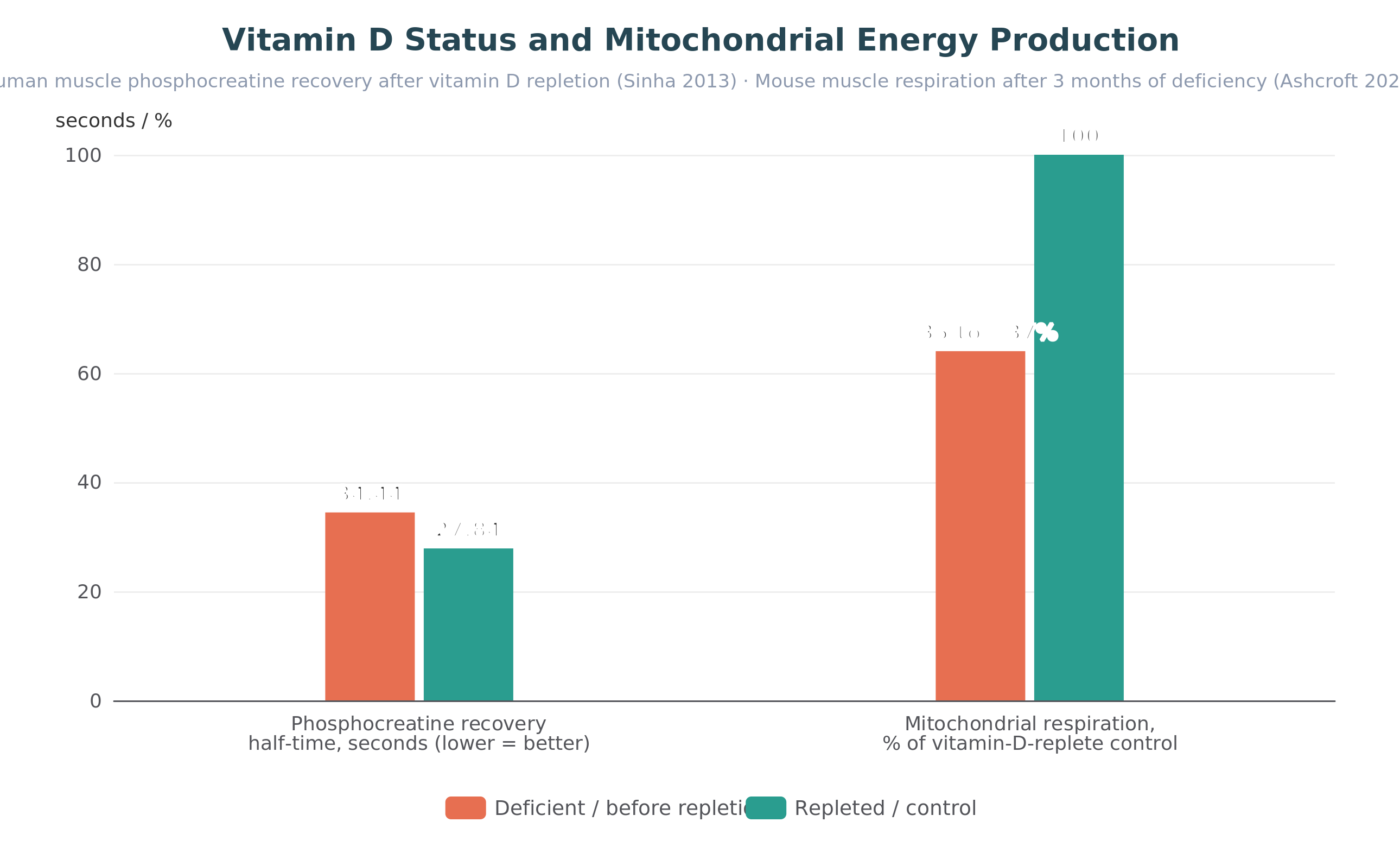
The most direct human evidence linking vitamin D to mitochondria comes from a 2013 study by Sinha and colleagues at Newcastle University, published in the Journal of Clinical Endocrinology & Metabolism. Twelve severely vitamin D–deficient adults (mean 25(OH)D of just 8.8 nmol/L — profoundly deficient by any guideline) underwent phosphorus-31 magnetic resonance spectroscopy, a non-invasive scan that tracks how quickly muscle regenerates phosphocreatine after exercise — a real-time readout of mitochondrial oxidative efficiency. After 10–12 weeks of vitamin D treatment (25(OH)D rising to ~114 nmol/L), the phosphocreatine recovery half-time improved from 34.4 to 27.8 seconds (p < 0.001), and every patient reported reduced fatiguePubMed. Across subjects, lower 25(OH)D correlated with slower mitochondrial recovery (r = −0.41, p = 0.009), and the authors described it as the first demonstration of a vitamin D–mitochondria link in human musclePubMed.
The study was small and lacked a placebo arm, so it establishes proof of principle rather than clinical certainty — but it landed on a foundation of converging mechanistic work. Its importance for a knowledge base is that it gives a human, in-vivo, dose-responsive data point: vitamin D status isn't merely correlated with how people feel; it tracks with the measurable energetic performance of the organelles that power every cell. Fatigue — the single most common complaint associated with low vitamin D — now has a candidate mechanism that can be seen on a scanner.
3.2 Mechanistic evidence: deficiency degrades the respiratory chain, and the VDR is the middleman#
Animal and cell studies have since filled in the mechanism with unusual completeness. Ashcroft and colleagues fed mice a vitamin D–free diet and found that after three months — with no change in mitochondrial protein content — mitochondrial respiration through complexes I+II fell by 35% and maximal electron-transport-chain capacity by 37% compared with vitamin D–replete controlsPubMed. A 2022 Communications Biology study extended this across rats, mice, and human myotubes: long-term vitamin D depletion reduced expression of mitochondrial biogenesis regulators NRF1 (−34%) and TFAM, cut the complex I subunit NDUFB8 protein by 66%, and blunted state-3 (ADP-stimulated) respiration; critically, mice with the vitamin D receptor knocked out specifically in skeletal muscle developed the same mitochondrial defects, establishing that the VDR itself is a required intermediate — not merely a correlated markerNature.
The mechanistic picture fits the hormone framing of Section 1: the VDR regulates mitochondrial genes genomically (NRF1, NRF2, respiratory-chain subunits), the activating enzyme 1α-hydroxylase resides in mitochondria, and vitamin D status influences oxidative-stress handling. This also explains why mitochondrial dysfunction — a hallmark of aging, sarcopenia, metabolic disease, and chronic fatigue — keeps intersecting with vitamin D research. The 2022 study explicitly frames vitamin D repletion as a candidate strategy against age-related muscle mitochondrial decline and sarcopenia, noting that deficient older humans regained muscle mass and strength with six months of supplementationNature. Vitamin D is not the whole mitochondrial story — Section 5 covers light's direct mitochondrial actions — but it is a validated input to the cell's energy economy, and deficiency demonstrably throttles it.
3.3 Why mitochondrial health is the unifying theme#
Mitochondria sit at the convergence of nearly every thread in this report, and it is worth making that explicit for readers. They convert food and oxygen into ATP; they house key enzymes of vitamin D activation; they absorb red and near-infrared photons at cytochrome c oxidase; they synthesize their own melatonin as a frontline antioxidant; and their dysfunction is implicated in metabolic disease, neurodegeneration, immune dysregulation, and aging itself. When a single lifestyle factor — time outdoors in full-spectrum daylight — simultaneously raises a hormone that supports mitochondrial gene expression (vitamin D), delivers photons that directly stimulate mitochondrial respiration (red/NIR), and entrains the circadian system that schedules mitochondrial repair cycles, the effects compound. This is the strongest scientific answer to "why not just take a pill?": the pill addresses one input to one organelle system, while the behavioral pattern the pill mimics addresses several at once. The remaining sections build that case piece by piece.
4. Sunlight Is Far More Than a Vitamin D Delivery System#
4.1 The spectrum we evolved under#
Vitamin D's UVB origin story has dominated public understanding of sunlight so completely that most people are surprised to learn how small a fraction of sunlight UV actually is. Of the solar energy reaching Earth's surface, ultraviolet accounts for only about 3–5% (and UVB itself a small fraction of that); visible light makes up about 42–43%, and infrared — mostly near-infrared — accounts for 52–55%ScienceDirect. The exact UV share depends on air mass and band convention: integrated over the standard ASTM G173 reference spectrum (AM1.5 global tilt), the sub-400 nm band holds roughly 5–7% of surface solar energy, the 400–700 nm visible band about 42%, and the infrared above 700 nm about halfNREL. In other words, the wavelength band that makes vitamin D is a sliver of the total signal, and the band that modern indoor life filters out most completely — near-infrared, which passes through neither most windows nor most LED lighting — is the majority of what the sun delivers.
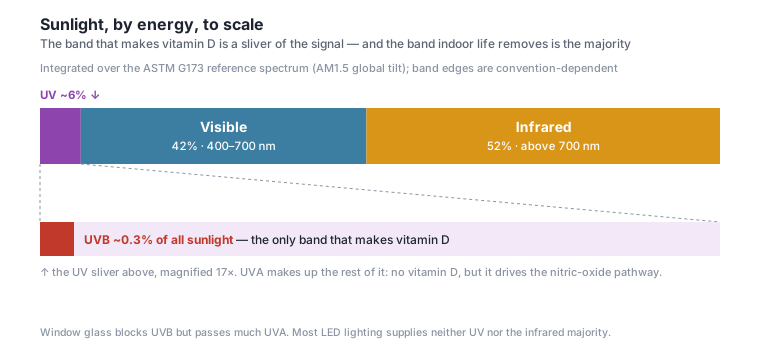
Human physiology evolved outdoors under this full spectrum, and the past century has radically re-engineered our exposure without any deliberate decision: we moved indoors (typical indoor lighting is 100–500 lux versus ~100,000 lux in daylight), we put glass between ourselves and the sky (blocking UVB and much infrared), and we replaced incandescent bulbs — whose spectrum, like sunlight, balanced blue and red — with LEDs dominated by blue wavelengths with "almost no red". UCL neuroscientist Glen Jeffery, whose lab studies light and mitochondria, puts the consequence bluntly: "our internal environments are red-starved," and chronic blue-weighted exposure without red balance "can drive disrupted blood sugars that may in the long run contribute to diabetes and undermine health spans" — a problem he notes "can partly be corrected by spending more time in sunlight". The following subsections walk through what each band does.
4.2 UVA and nitric oxide: sunlight's vitamin D–independent cardiovascular pathway#
The best-established non-vitamin D pathway runs through nitric oxide (NO). Human skin holds large stores of nitrogen oxides (nitrate and nitrite), and dermatologist Richard Weller's group showed that UVA exposure mobilizes these stores, releasing NO into the circulation, dilating arteries, and measurably lowering blood pressure — an effect independent of vitamin D, since UVA (315–400 nm) does not drive vitamin D synthesisPubMed. Population data fit the mechanism: blood pressure and cardiovascular deaths are higher in winter and at higher latitudes, and Weller's analysis found that about half of the seasonal variation in blood pressure is independent of temperature — attributable to UV alonePubMed. The estimated effect of restoring summer-level sunlight in winter is a 2–3 mmHg systolic reduction; small individually, but a 3 mmHg population-level drop translates to roughly a 10% reduction in cardiovascular eventsPubMed.
The UK Health Security Agency's own research program now recognizes this pathway, describing UV-activated nitric oxide release in skin as a blood-pressure-lowering mechanism supported by laboratory, clinical-trial, and epidemiological data. The cardiovascular significance is amplified by the mortality data in Section 8.3: in the Swedish MISS cohort, the survival advantage of sun-active women was driven mainly by lower cardiovascular and non-cancer/non-CVD deaths — precisely the categories the NO pathway predicts, and not the pattern one would expect if vitamin D alone were responsiblePubMed. It is worth noting the professional disagreement here: dermatology bodies such as the American Academy of Dermatology maintain strict sun-avoidance guidance (shade, SPF 30+, avoiding midday sun), so this remains an active scientific and policy debate rather than settled consensus. A knowledge base should present both the mechanism and the ongoing argument.
4.3 UV and the immune system: engineered tolerance, not just suppression#
Sunlight's effect on immunity is older science than most people realize — phototherapy has treated inflammatory skin disease for over a century — but the mechanism turns out to be sophisticated systemic regulation rather than crude "immunosuppression." UV exposure generates antigen-specific regulatory T cells (Tregs) that release the anti-inflammatory cytokine IL-10 and, once activated, suppress immune responses generally ("bystander suppression")PubMedPMC. It also induces tolerogenic dendritic cells, migrates mast cells to lymph nodes, and expands regulatory B cells — a coordinated, multi-cellular shift toward immune tolerance that begins in skin and propagates systemically, lasting days to monthsPMCMDPI. In humans, controlled daily sun exposure over 16 days reduced circulating skin-homing T cells and cut their capacity to secrete IFN-γ, IL-17, and TNF-α — measurable systemic immunomodulation from ordinary sunlightFrontiers.
The most striking recent finding is that UV even mimics a blockbuster drug. Researchers found that skin UV exposure raises sphingosine-1-phosphate (S1P) in lymph nodes, down-regulating the S1P receptor on T cells and trapping them in the nodes — the same sphingosine-1-phosphate pathway exploited by fingolimod (Gilenya), a frontline multiple sclerosis therapyPubMed. Epidemiology points the same direction. In two large Swedish case-control studies, low sun exposure raised MS risk both directly (OR 1.26) and indirectly through vitamin D deficiency (OR 1.10), with only ~30% of the effect mediated by vitamin D — meaning most of sunlight's association with MS protection runs through non-vitamin D pathwaysPubMedSpringer. A 2025 meta-analysis of gene–environment studies found that carriers of the main MS risk gene (HLA-DRB1*15:01) with low sun exposure had over five times the MS risk (aOR 5.17), with significant additive interactionmsard-journal.com. And in a death-certificate case-control study, outdoor workers in high-sunlight regions had an MS odds ratio of 0.24 versus indoor workers — a 76% lower oddsPubMed. Together with the VITAL autoimmune results (Section 9), this builds a coherent picture: light exposure trains the immune system toward tolerance, and its absence removes that training.
5. Red and Near-Infrared Light: Photobiomodulation and the Mitochondrial Connection#
5.1 The mechanism: light switches the cell's power plant back on#
Photobiomodulation (PBM) — the use of red (~620–700 nm) and near-infrared (~700–1200 nm) light to modulate biology — has accumulated roughly fifty years of experimental literature, and its core mechanism is now well characterized. The primary photoacceptor is cytochrome c oxidase (CCO), complex IV of the mitochondrial electron transport chain, which contains heme and copper centers that absorb red and NIR photons. Under stress, nitric oxide binds CCO and inhibits it, throttling respiration; the leading hypothesis — supported by the major mechanistic reviews — is that absorbed photons photodissociate this inhibitory NO from CCO, restoring electron flow, raising mitochondrial membrane potential, and increasing ATP output, while the released NO acts as a local vasodilator and signaling moleculePubMedPMC. Downstream, brief bursts of reactive oxygen species, cAMP, NO, and Ca²⁺ activate transcription factors that upregulate genes for protein synthesis, cell migration, anti-inflammatory signaling, anti-apoptotic proteins, and antioxidant enzymesPMC.
Two properties make this pathway especially relevant to an outdoor-health platform. First, penetration: red light passes millimeters into tissue and NIR several centimeters, meaning sunlight's majority wavelength band reaches deep musculature, and to some degree internal organs and the brain — light does not stop at the skinPMC. Second, the dose-response is biphasic (Arndt-Schulz-like): too little does nothing, a moderate dose stimulates, and an excessive dose inhibits — which is why PBM researchers emphasize that dosing matters and why "more light" is not unconditionally better, a nuance a responsible knowledge base should preservePubMed.
5.2 Human evidence: measurable metabolic effects within minutes#
The landmark human demonstration came from Powner and Jeffery in 2024 (Journal of Biophotonics). Thirty healthy adults received a single 15-minute exposure to 670 nm red light on the upper back — covering only about 4% of skin surface — 45 minutes before an oral glucose tolerance test. Compared with placebo, the red-light group showed a 27.7% reduction in the post-glucose rise in blood glucose integrated over two hours (p = 0.0002), a 7.3% reduction in total circulating glucose, and a blunted peak glucose spikePubMedWiley. The mechanism interpretation is that stimulated mitochondria increased their glucose demand, pulling sugar out of the bloodstream — and the systemic effect from a small illuminated area implies circulating signals carry the benefit beyond the lit tissuePubMed.
The same research program has shown 670 nm light improves age-related decline in retinal function, and animal work shows benefits in models of Parkinson's disease and diabetic retinopathy from light applied to the back — again indicating body-wide signalingPubMed. These are early-stage human results from one research lineage, and a knowledge base should say so; but the underlying physics is not exotic. It is the same red/NIR band that constitutes over half of natural sunlight, delivered by a lamp instead of the sun. The PBM literature thus reframes everyday sunlight: the largest component of the solar spectrum is not thermal noise but a biologically active input to mitochondrial respiration — one that glass, clothing, and LED lighting have quietly engineered out of modern lifePubMed.
5.3 The other melatonin: sunlight's daytime antioxidant signal#
Melatonin's popular identity as the "sleep hormone" secreted by the pineal gland at night is accurate but radically incomplete. Pineal production accounts for only a minority of the body's melatonin; the bulk is produced locally in tissues — and specifically inside mitochondria, where the synthetic enzymes SNAT and ASMT are localized and where melatonin concentrations are high, serving as a frontline antioxidant exactly where oxidative stress is generatedPMC. The alpha-proteobacterial ancestors of mitochondria could synthesize melatonin, suggesting this capacity is a billion-plus-year-old cellular defense retained through evolutionPMC.
The connection to sunlight is the frontier finding: near-infrared radiation — the major wavelength band of sunlight, penetrating inches into the body and interacting with "virtually all of our cells" — promotes this extra-pineal, mitochondrial melatonin production, leading Tan, Reiter, and colleagues to propose that many benefits of sun exposure and photobiomodulation are partly mediated by NIR-induced local melatoninPMC. Crucially, this system is the mirror image of the pineal one: blue light (~480 nm) suppresses pineal melatonin (the wake signal), while NIR stimulates mitochondrial melatonin (the repair signal), and the two operate on opposite schedules by designPMC. This dual-melatonin framework elegantly unifies the report's threads: morning-to-midday full-spectrum light simultaneously switches on mitochondrial energy production and mitochondrial antioxidant defense, while evening darkness releases the pineal rhythm that schedules sleep and systemic repair. An indoor, LED-lit, screen-lit lifestyle inverts both signals at once — dim and red-starved by day, blue-bright by night.
5.4 Photobiomodulation in perspective#
For OPSIN's purposes, PBM research matters in two directions. Outward, it validates the premise that wavelength-specific light exposure is a legitimate, mechanistically grounded health input — not wellness folklore — giving the knowledge base a rigorous bridge from "get some sun" to "understand what different light does." Inward, it offers a caution against overclaiming: the PBM field itself stresses that human trial evidence is still young, that device dosing follows a biphasic curve, and that laboratory findings in cells and mice outrun clinical confirmationPubMedPubMed. Presenting red/NIR science with this calibration — strong mechanism, promising early human data, research ongoing — will age far better than hype, and it positions sunlight as the original, free, full-dose photobiomodulation source that devices merely approximate.
6. Opsins and the Circadian System: Light Through the Eyes — and the Skin#
6.1 Melanopsin (OPN4): the eye's clock-setting channel#
The namesake of OPSIN deserves center stage, because opsins are the molecular interface between light and virtually every time-keeping process in the body. Beyond the rods and cones of vision, the retina contains intrinsically photosensitive retinal ganglion cells (ipRGCs) expressing melanopsin (OPN4), a blue-light-sensitive opsin (peak ~480 nm). These cells do not form images; they report ambient brightness directly to the suprachiasmatic nucleus (SCN), the brain's master circadian clock, as well as to circuits governing the pupillary reflex, alertness, mood, and learningPMC. Through this channel, morning daylight advances and stabilizes the daily rhythm, daytime brightness sustains alertness, and evening darkness permits the pineal melatonin rise — the master timing signal by which every peripheral clock in the body (liver, muscle, gut, immune cells) is synchronized.
The behavioral evidence for getting this signal right is extensive, and the light dose involved is one most indoor environments cannot deliver: a typical office provides 100–500 lux, while an overcast day outdoors provides ~10,000 lux and direct sun ~100,000 lux. The circadian system therefore experiences modern indoor life as perpetual dim twilight. The downstream consequences of mistimed light are not subtle — they show up in the melatonin data below and in the metabolic and mood epidemiology of circadian disruption — and they constitute the single most actionable light-health behavior: bright light by day, dim light by night.
6.2 Light at night: the quantified cost of getting the signal backwards#
Gooley and colleagues quantified what ordinary evening lighting does to the darkness signal. In 116 healthy young adults living under controlled conditions, exposure to typical room light (<200 lux — a normally lit living room, not a screen held to the face) in the eight hours before bedtime delayed melatonin onset in 99% of participants, compressed melatonin duration by about 90 minutes, and suppressed pre-sleep melatonin levels by 71.4% compared with dim light (<3 lux); room light maintained during habitual sleep hours suppressed melatonin by more than half in 85% of trialsPMCPubMed. Because melatonin signaling influences sleepiness, thermoregulation, blood pressure, and glucose homeostasis, the authors note chronic evening light exposure "could therefore potentially impact" all of themPubMed.
This is the dark-side counterpart of the OPSIN thesis, and including it strengthens rather than weakens the platform's credibility: the circadian system reads light as information, and the same channel that makes morning sun beneficial makes midnight screen light costly. The practical pairing — maximize outdoor light in the first half of the day, minimize artificial light in the last hours before sleep — is the most evidence-secure light prescription available. Notably, adolescents show melatonin suppression even from afternoon-to-evening bright light, suggesting sensitivity windows extend earlier in the day than commonly assumedNature.
6.3 OPN5, OPN3, and the frontier: light sensing beyond the eye#
The newest chapter of opsin biology is the discovery that the eye is not the body's only light meter. Neuropsin (OPN5), a violet/UVA-sensitive opsin (peak ~380 nm), is expressed in retina, skin, cornea — and in the preoptic area of the hypothalamus, where mouse studies show it functions as a genuine deep-brain photoreceptor: violet light detected by hypothalamic OPN5 neurons acutely suppresses brown-fat thermogenesis, and OPN5 in skin directly photo-entrains the skin's own circadian clockPMC. Encephalopsin (OPN3) is expressed in adipocytes, where blue light acting through it promotes lipolysis — fat cells, in effect, can sense daylightPMCPubMed. Reviewers describe OPN5 as potentially "the first deep-brain photoreception observed in mammals," reshaping the paradigm that mammals sense light only through their eyesPMC.
Honest reporting requires flagging how young this field is: these functions are established in mice, while "human OPN5 has not been associated at this stage with any validated function," and primate lenses filter most sub-400 nm light, so translation to human physiology is unresolvedPMC. But the direction of discovery is unmistakable — opsins keep turning up in skin, fat, vasculature, and brain — and for a brand literally named OPSIN, this frontier is a gift: the science increasingly supports the founding intuition that the body is listening to light through far more channels than vision. Skin-level light sensing also mechanistically reframes the gut–skin axis findings of the next section: the skin is not a passive tarp but a photosensitive organ that talks to the immune system, the metabolism, and the microbiome.
7. Light, Vitamin D, and the Gut Microbiome#
7.1 The skin–gut axis: a week of UVB light reshapes intestinal bacteria#
The most direct evidence that light reaches the gut came from Bosman and colleagues at the University of British Columbia in 2019 (Frontiers in Microbiology). Twenty-one healthy women received three one-minute full-body narrowband UVB sessions in a single week. In the twelve participants who had not been taking vitamin D supplements (and started with lower vitamin D status and less diverse microbiomes), UVB exposure significantly increased both alpha and beta diversity of the gut microbiome, raising their microbial richness to levels indistinguishable from the supplemented group; serum 25(OH)D rose by an average of 7.3 nmol/L in parallelFrontiersPMC. The largest shift was enrichment of Lachnospiraceae — a family of butyrate-producing bacteria whose abundance correlated directly with participants' serum 25(OH)D (p = 0.004)PMC. The supplemented group, starting from sufficiency, showed no further change, implying light moves the microbiome most when vitamin D status is lowFrontiers.
A comparative commentary then connected the laboratory finding to free-living humans: the Yanomami, an Amazonian hunter-gatherer population with near-constant natural sun exposure and no sunscreen, show the same microbiome signature — high diversity, elevated Firmicutes and Proteobacteria, abundant Lachnospiraceae and Ruminococcus — that the UVB sessions induced in Vancouver women, leading the authors to propose that "UVB light/sunlight is a tangible factor that should be considered as a modulator of the gut microbiome"PMCPMC. The proposed skin–gut axis mechanism is sequential: UVB striking skin raises vitamin D and modulates cutaneous immune cells, and these signals systemically reshape the intestinal environment that bacteria compete inPMC. This was a small pilot study, but it was the first human demonstration that light exposure alone, within one week, changes the gut ecosystem — a landmark concept for an outdoor-health knowledge base.
7.2 The vitamin D–gut machinery: barrier, antimicrobials, and a two-way street#
The molecular plumbing beneath the skin–gut axis runs through the VDR, and it is bidirectional. On the outward direction, vitamin D signaling maintains the intestinal barrier by supporting tight-junction proteins (reducing permeability and the inflammation that "leaky" barriers drive) and induces antimicrobial peptides such as cathelicidin (LL-37) and defensins in gut tissue, which directly shape which bacteria can thrivePMC. The immune-cell mechanism described earlier applies here too: monocytes and dendritic cells convert free 25(OH)D into active hormone on-site via their own 1α-hydroxylase, and the resulting intracrine signaling drives antimicrobial peptide production and tolerogenic T-cell responses — with DBP levels and genotype modulating how much substrate the cells actually receivePMC. Vitamin D deficiency, conversely, has been linked to dysbiosis and inflammatory bowel disease in both animal and human dataPMCPubMed.
On the return direction, gut microbes influence vitamin D handling: certain probiotic strains have been shown to raise serum 25(OH)D, and microbial metabolites such as secondary bile acids can themselves signal through the VDR, meaning the gut is both a target and a modulator of vitamin D biology. The practical synthesis for readers is that the gut microbiome — now tied to immune regulation, metabolic health, mood, and inflammation — is not governed by diet alone. Light exposure and vitamin D status are measurable levers on its diversity and composition, operating through a documented skin–gut axisFrontiersPMC. That is a genuinely novel message most gut-health content does not deliver, and it slots naturally beside OPSIN's core outdoor thesis: the same midday walk that sets your circadian clock and tops up a hormone also feeds back into the ecosystem in your intestines.
8. Outdoors as Medicine: The Evidence Beyond Molecules#
8.1 The outdoor-light prescription that already works: childhood myopia#
The strongest randomized evidence that outdoor time itself — not a supplement, not a device — prevents disease comes from an unexpected organ: the eye. In a cluster-randomized trial in Guangzhou, adding one 40-minute outdoor class to each school day reduced the 3-year cumulative incidence of myopia from 39.5% to 30.4% among ~1,900 six-year-olds (a 9.1-percentage-point absolute reduction, p < 0.001)PubMed. A larger three-arm Shanghai trial of 6,295 children (with wrist-worn sensors objectively tracking light exposure) found adjusted myopia incidence fell 16% with +40 min/day and 11% with +80 min/day of school-day outdoor time; dose analysis showed children achieving 120–150 minutes of daily outdoor time at ~5,000 lux had 15–24% lower incidence riskPubMed.
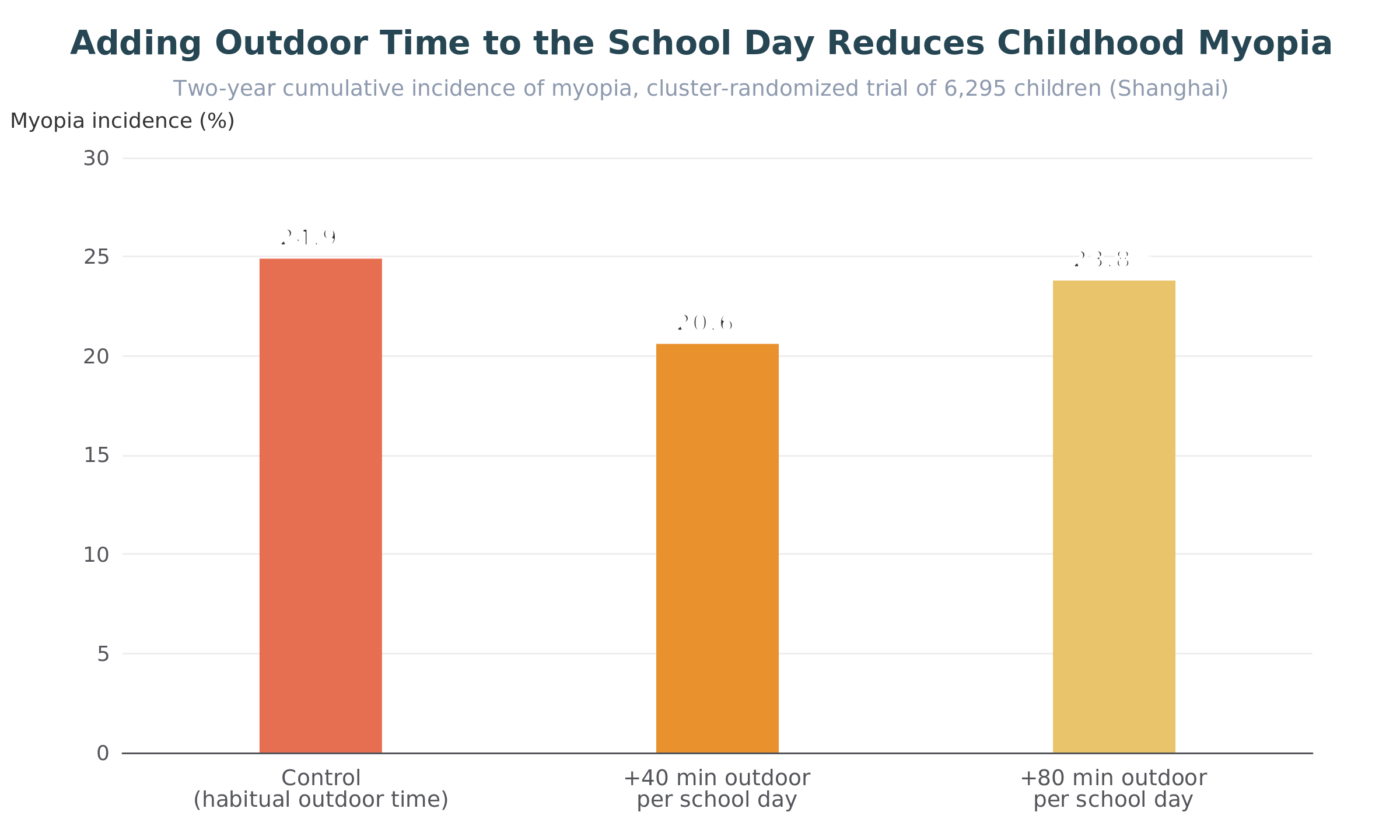
The mechanism is believed to involve bright-light-driven retinal dopamine release, which slows the axial elongation of the eye that causes myopia — a light-intensity effect, not a vitamin D or physical-activity effect, which is why it fits this report. Its broader lesson generalizes: this is a case where epidemiology identified a protective factor (outdoor time), randomized trials confirmed causality, dose-response was characterized, and the "drug" is simply being outside in daylight. With myopia now at epidemic levels in East Asia and rising globally, school systems are literally prescribing outdoor time — a template for how light-exposure medicine could mature in other domains.
8.2 The nature dose: two hours a week as a health threshold#
Outdoor exposure bundles light with green space, movement, and psychological restoration, and the epidemiology treats the bundle seriously. Analyzing a nationally representative sample of nearly 20,000 English adults, White and colleagues found that people reporting at least 120 minutes of nature contact per week were substantially more likely to report good health (OR 1.59, 95% CI 1.31–1.92) and high well-being (OR 1.23, 95% CI 1.08–1.40) than those with zero contact — while 1–119 minutes conferred no detectable benefit, suggesting a genuine thresholdPubMed. Benefits peaked around 200–300 minutes weekly, held across age, sex, ethnicity, income, urban/rural residence, and even among people with long-term illness, and did not depend on whether the two hours came in one visit or many short onesPubMed.
The authors contextualized the effect size as comparable to the health associations of meeting physical-activity guidelines or living in a low-deprivation area — large enough, they argue, to justify nature-contact guidelines modeled on exercise guidelinesPubMed. Shorter doses matter too: other experimental work shows even 20–30-minute nature visits measurably reduce salivary cortisol, with the steepest efficiency gains in that windowPubMed. For OPSIN's knowledge base, this literature supplies the non-photobiological half of the outdoor argument: daylight is the most mechanistically specific reason to go outside, but the total outdoor package — light, movement, greenness, stress recovery — is itself a documented, dose-dependent health behavior with a memorable, achievable target: two hours a week, minimum.
8.3 The mortality data: sun avoidance as a risk comparable to smoking#
The most provocative population evidence comes from the Melanoma in Southern Sweden (MISS) cohort, which followed 29,518 women for 20 years with detailed baseline sun-exposure histories. All-cause mortality was inversely related to sun exposure in a dose-dependent fashion: compared with the highest-exposure group, women with moderate exposure had 40% higher mortality (HR 1.4, 95% CI 1.1–1.7) and sun avoiders had double the mortality (HR 2.0, 95% CI 1.6–2.5), corresponding to a population attributable risk of 3%PubMed. A competing-risk analysis showed the survival advantage of sun-active women was driven by fewer cardiovascular and non-cancer/non-CVD deaths, and that nonsmoking sun-avoiders had a life expectancy similar to smokers in the highest-exposure group — i.e., sun avoidance carried a mortality risk of similar magnitude to smoking, with life expectancy 0.6–2.1 years shorterPubMed.
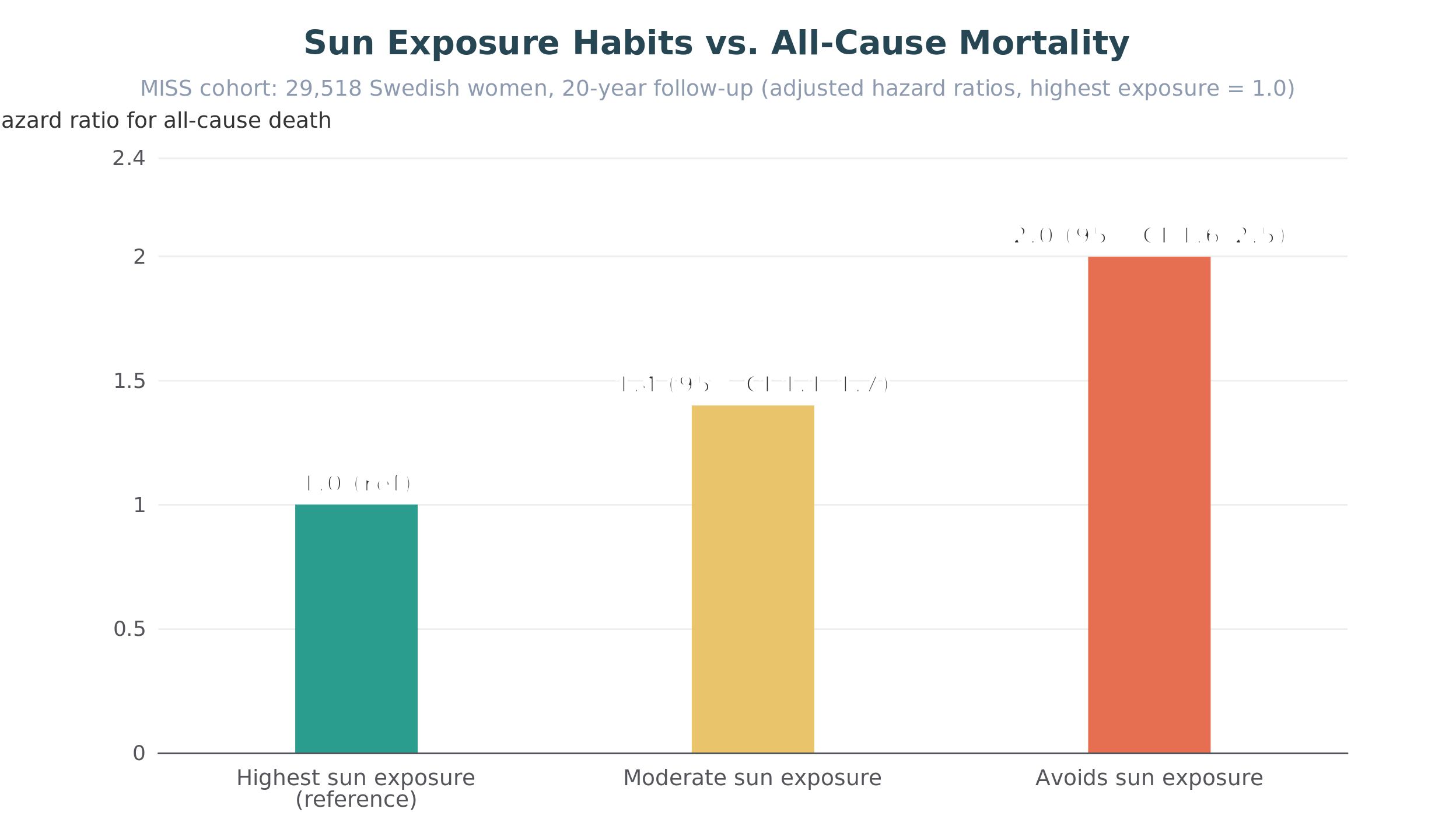
Three caveats belong alongside these numbers. First, the study is observational — residual confounding by lifestyle is possible, as Cancer Research UK noted in response, though the authors adjusted for income, smoking, comorbidity, education, exercise, and BMIPubMed. Second, the same cohort confirms sun exposure's real harms: melanoma incidence rose with sun exposure, even as melanoma survival was better in high-exposure women (case fatality 35% in low-exposure versus 13% in the highest-exposure group) — a paradox consistent with intermittent burning, not chronic exposure, driving melanoma riskAnticancer Research. Third, these were light-skinned Scandinavian women at 55–67°N, and the authors themselves caution that guidance built for high-UV Australia may be harmful when transplanted to low-sunlight countriesPubMed. The balanced takeaway — echoed even by mainstream commentators at the time — is not "the more sun the better" but that for northern populations "the ideal amount is a little rather than zero": enjoy the sun, don't burn.
9. Pill vs. Sunshine: What the Big Trials Actually Found#
9.1 VITAL's headline: null on the primary endpoints, but the story doesn't end there#
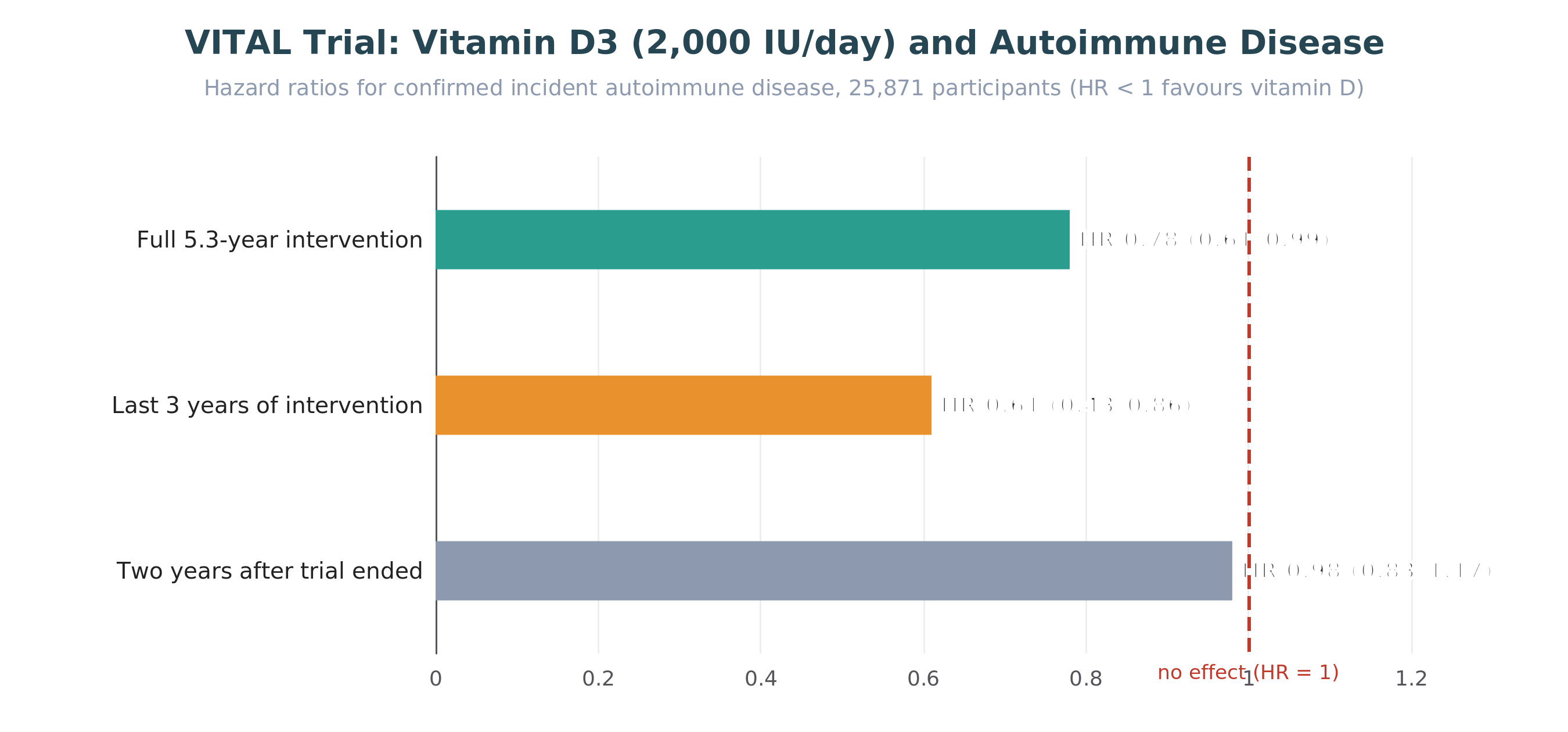
Any honest account must center VITAL, the largest vitamin D trial ever run: 25,871 U.S. adults (men ≥50, women ≥55) randomized to 2,000 IU/day of vitamin D3 versus placebo for a median 5.3 yearsPubMed. On its primary endpoints — total invasive cancer and major cardiovascular events — vitamin D showed no significant reduction, and these nulls are routinely cited to declare the vitamin D question closed. But the trial's secondary and ancillary findings tell a more nuanced story, and its design limitations are directly relevant to the pill-versus-sunlight question. Participants were largely vitamin D–replete at baseline, everyone (including the placebo arm) was permitted up to 800 IU/day of outside supplementation, and the intervention titrated a nutrient in a population that mostly wasn't deficient — a design critics argue tests "a little more versus enough" rather than "enough versus deficient."
The most consequential positive result was autoimmune disease. Over the intervention period, the vitamin D arm developed 22% fewer confirmed autoimmune diseases than placebo — 123 versus 155 cases, HR 0.78 (95% CI 0.61–0.99)PubMed. The effect strengthened with adherence time: restricted to the final three years, the reduction reached 39% (HR 0.61, p = 0.005) — consistent with slow-moving autoimmune pathology requiring sustained exposurePubMed. And telling for mechanism, when participants were observed for two additional years after the trial ended, the protection dissipated (HR 0.98) — vitamin D acts while the exposure continues, like the sunlight behavior it mimics, rather than conferring permanent immunityPubMed.
9.2 Why trials of pills keep underselling sunlight#
The VITAL pattern — modest or null primary results, meaningful benefits in slower outcomes and sustained-exposure analyses — recurs across the supplement-trial literature, and the research reviewed in this report suggests at least four structural reasons. First, baseline repletion: modern mega-trials enroll generally nourished volunteers, diluting any effect toward null. Second, the free-hormone problem: trials titrate total 25(OH)D, but tissues respond to free/bioavailable fractions shaped by DBP concentration and genotype, so equal blood targets deliver unequal cellular dosesPMC. Third, dissipation and timing: the autoimmune protection vanished within two years of stopping, implying benefits require ongoing exposure — a property of sunlight habits, not of a five-year pill coursePubMed. Fourth, and most fundamental: a capsule contains one molecule; sunlight is a spectrum. UVB–vitamin D, UVA–nitric oxide, blue–circadian entrainment, and red/NIR–mitochondrial pathways all engage simultaneously outdoors, so a vitamin D pill can at best replicate one channel of a multi-channel signalPubMedPubMedPubMed.
This is not an argument against supplementation — for people in deficiency, at northern latitudes in winter, with dark skin in low-sun environments, or with malabsorption, supplements are often the only practical channel, and the 2024 Endocrine Society guideline itself recommends above-RDA supplementation for children, pregnancy, adults over 75, and prediabetesPubMed. The argument is about interpretation: "vitamin D pills don't reproduce all the associations of sun exposure" is evidence that sunlight is more than vitamin D, not evidence that sunlight doesn't matter. For OPSIN, this is the pivotal message that connects the vitamin D calculator to the broader mission — the app can help people close the gap when the sun can't, while the knowledge base teaches why the sun remains the reference standard the pill is trying to copy.
9.3 Reading the totality: an evidence-strength map#
A knowledge base earns trust by grading rather than flattening its evidence. The table below summarizes the major claims of this report against the strength of their supporting evidence — the distinction that separates a rigorous resource from wellness content.
| Claim | Key evidence | Evidence strength |
|---|---|---|
| Vitamin D is a secosteroid hormone; VDR regulates ~3% of the genome | Mechanistic reviews, receptor biologyPMC | Established |
| IOM RDA contains a ~10× statistical underestimate | Re-analysis of IOM data; independent cohort confirmationPMCPMC | Strong (published, contested) |
| Blood 25(OH)D ≠ cellular availability; free fraction drives tissue action | DBP physiology, monocyte cathelicidin experimentsPMCPMC | Strong mechanistic |
| Vitamin D status modulates mitochondrial energy production | Human MR-spectroscopy trial; animal respiration studies; muscle VDR knockoutPubMedPubMedNature | Moderate–strong |
| UVB light reshapes the gut microbiome within a week | Human pilot trial (n=21) + hunter-gatherer comparisonFrontiersPMC | Preliminary but direct |
| UVA lowers blood pressure via skin nitric oxide, vitamin D–independent | Human mechanistic studies; population analyses; UKHSA programPubMed | Strong mechanistic, moderate population |
| UV induces systemic immune tolerance (Tregs, S1P trapping) | Decades of immunology; human sun-exposure studiesPubMedPubMedFrontiers | Established mechanism |
| Red/NIR light stimulates mitochondria; 670 nm blunts glucose spikes 27.7% | Mechanistic reviews; human RCT (n=30)PubMedPubMed | Established mechanism, early human trials |
| Mitochondria make their own melatonin, stimulated by NIR | Biochemical localization; synthesis-review hypothesisPMC | Emerging |
| Evening room light suppresses melatonin ~71%, shortens it 90 min | Controlled inpatient study (n=116)PMCPubMed | Strong |
| Outdoor time prevents childhood myopia (16–24% risk reduction) | Two cluster-RCTs (n ≈ 1,900 and 6,295)PubMedPubMed | Strong (causal) |
| 120+ min/week in nature associated with better health | Nationally representative survey (n ≈ 20,000)PubMed | Moderate (observational) |
| Sun avoidance associated with doubled mortality | 20-year prospective cohort (n = 29,518)PubMedPubMed | Moderate (observational, confounding possible) |
| Vitamin D (2,000 IU/d) reduces autoimmune incidence 22–39% | VITAL RCT (n = 25,871); post-trial dissipationPubMedPubMed | Strong (causal) |
| Skin/deep-brain opsins (OPN3, OPN5) sense light outside the eye | Mouse studies; human function unprovenPMCPMC | Frontier (preclinical) |
10. Practical Synthesis: Working With the Sun#
10.1 What actually controls vitamin D production in skin#
For a platform whose origin is a vitamin D calculator, the production variables are the core curriculum — and the numbers are more dramatic than most users expect. Cutaneous synthesis requires UVB at sufficient intensity, conventionally a UV Index of 3 or above, which is why production is seasonal: at ~40° latitude (Boston, 42°N) there is effectively no vitamin D synthesis from November to early March, and at Edmonton's latitude the "vitamin D winter" runs October through AprilLinus Pauling InstitutePubMed. Time of day matters just as much: a solar altitude above 45° — the practical "shadow rule" that your shadow should be shorter than you are tall — is when UVB suffices; modeling for Hannover (52°N) found the skin time needed to synthesize 1,000 IU ranged from 1.1 minutes on June 21 to 39 minutes on December 21 under clear skies, and effectively impossible under December cloudNature.
| Factor | Effect on vitamin D synthesis | Practical reading |
|---|---|---|
| Latitude / season | None Nov–Mar at ~40°N; Oct–Apr at ~52°N+Linus Pauling Institute | Winter sun walks give light, not vitamin D — supplement or rely on stores |
| Time of day | Midday (11:00–15:00) optimal; shadow shorter than height = UVB sufficientPubMedNature | The same 15 minutes is worth far more at noon than at 5 pm |
| Skin pigmentation | Dark skin may need up to 10× longer for equal productionLinus Pauling Institute | One-size guidance fails; darker skin at high latitude is highest-risk |
| Age | Older skin holds less 7-DHC precursor, reducing synthesis capacityLinus Pauling Institute | Older adults need more time or supplementation |
| Sunscreen | SPF 8 sunscreen essentially abolished the skin's vitamin D₃ rise after a full-body standard erythemal dose in the classic controlled experimentPubMed | Time-limited unprotected exposure vs. burn protection is the real trade-off |
| Glass / clothing | UVB does not pass window glass; covered skin does not synthesizeLinus Pauling Institute | "Sitting by a sunny window" yields ~zero vitamin D |
| Cloud / pollution | Heavy cloud can halve or eliminate effective UVBPubMedNature | Bright overcast ≠ productive UVB |
| Surface area & dose | Production self-limits (photochemical equilibrium); arms/legs/backs beat face/handsPubMed | Short, broader-area exposure beats long face-only exposure |
One design feature of the skin's vitamin D system deserves emphasis because it resolves a common fear: cutaneous production is self-limiting. Once previtamin D3 accumulates, continued UV exposure simply converts it into inert photoproducts (lumisterol and tachysterol) rather than more vitamin D, so sun-derived vitamin D cannot reach toxic levels — toxicity cases in the literature come from supplements, not sunlightLinus Pauling InstitutePubMed. This built-in ceiling, combined with the fact that a single full-body minimal erythemal dose can produce the equivalent of roughly 10,000 IU, is why researchers describe the skin as a buffered, feedback-regulated hormone factory rather than a simple on/off converter — and why short, regular exposures beat marathon sessions for efficiency and safety alikeLinus Pauling Institute.
How much vitamin D does one standard erythemal dose actually yield? The published estimates diverge by roughly an order of magnitude, and this document presents them as an attributed range rather than a single number. At the high end sits Holick's widely quoted figure that a full-body 1-MED exposure produces the equivalent of ~10,000–25,000 IULinus Pauling Institute. Direct experimental work points lower: Terushkin and colleagues, exposing 25.5% of body surface (type III skin) to Boston noon sun, estimated 400 IU from 3–8 minutes in the April–October season — which scales to roughly 1,600–3,100 IU per minimal erythemal dose for that body area, and implies Miami-like latitudes need 3–6 minutes while Boston in winter produces effectively nothing at any practical exposurePubMed. Computational models sit lower still: the clear-sky spectral model behind OPSIN's production engine implies per-minute yields below the erythemally weighted estimates, because it integrates the full previtamin-D action spectrum through an atmospheric transfer model rather than using erythema-weighted shortcutsNature. The spread is methodological, not biological: different action-spectrum weightings, body-surface assumptions, atmospheric models, and definitions of "1 MED" produce different answers to the same question. OPSIN's own estimates follow the spectral-model convention, and our Methodology page says so — which is the honest way to handle a quantity the literature has not converged on.
10.2 An evidence-anchored daily light routine#
The research reviewed here converges on a set of behaviors that respect both the benefits and the genuine risks. These are presented as education, not medical advice, and deliberately graded to what the evidence supports:
| Practice | Basis | Strength of support |
|---|---|---|
| Get outdoor light early in the day (morning to midday) | Melanopsin–SCN entrainment; daytime lux 10–100× indoor levelsPMC | Strong |
| When UV Index ≥ 3 and shadow is short, get brief unprotected skin exposure — minutes, not hours, never to redness | Vitamin D synthesis physics; sub-erythemal dosingLinus Pauling InstitutePubMed | Strong for synthesis; individualize by skin type |
| Maximize midday outdoor time in winter even without vitamin D yield | NIR/mitochondrial, circadian, NO, mood pathways don't require UVBPMCPubMed | Moderate |
| Accumulate 120+ minutes/week outdoors, ideally 200–300 | Nature-dose threshold dataPubMed | Moderate |
| Treat evening as a light fast: dim home lighting in the last 1–2 hours before bed | Room-light melatonin suppression dataPMC | Strong |
| Know your personal synthesis factors (skin tone, latitude, age) and supplement when the sun can't deliver | Production-variable data; Endocrine Society high-risk groupsLinus Pauling InstitutePubMed | Strong |
| Protect against burning — the melanoma risk tracks intermittent burns, not moderate regular exposure | Cohort data on melanoma incidence vs. exposure patternAnticancer Research | Strong consensus |
What makes this routine coherent — rather than a grab-bag of tips — is that each practice targets a different, non-overlapping light pathway documented in this report. Morning light works through melanopsin and the master clock (Section 6); midday UVB feeds the hormone system and, at sufficient dose, the gut–skin axis (Sections 1, 2, 7); the broad daytime spectrum delivers UVA's nitric oxide signal and near-infrared's mitochondrial input even when UVB is absent in winter (Sections 4, 5); outdoor accumulation captures the nature-dose threshold (Section 8); and the evening light fast protects the pineal darkness signal that daytime habits can't substitute for (Section 6.2). None of these practices conflicts with another, and none requires exotic equipment — the "device" is the sun, and the "prescription" is mostly about timing.
10.3 Safety, balance, and the burning question#
No responsible treatment of this subject can skip skin cancer, and the honest framing is a dose-shape argument rather than a sun-versus-no-sun argument. UV radiation is a proven carcinogen; dermatology bodies recommend shade, clothing, and SPF 30+, and melanoma incidence in the Swedish cohort did rise with sun exposurePubMedPubMed. But the same cohort found sun avoidance carried the larger mortality burden, and expert commentary across the spectrum converges on a similar synthesis: the hazard concentrates in intermittent high-dose burning, while moderate, regular, non-burning exposure appears to carry net benefit in low-sunlight regions — "a little rather than zero," in the words of Cancer Research UK's responding experts, "enjoy the sun safely while taking care not to burn". Lindqvist's team likewise notes that relying on sunscreen to extend time in strong sun is itself unproven for melanoma safety, and that in a country where the UV Index exceeds 3 only a few months a year, daily short midday exposure is the rational defaultAnticancer Research.
The practical risk-management rule set that emerges is: dose for sub-erythemal exposure (well below any reddening), prefer shorter midday sessions over long low-angle ones for vitamin D efficiency, cover up or shade once the productive window passes, and never use "vitamin D" as a reason to tan through burning. Skin type changes every one of these numbers — fair skin both synthesizes faster and burns faster — which is exactly the kind of personalization an app like OPSIN can deliver better than any static guidelineLinus Pauling Institute. Presenting this balance explicitly is what will distinguish the OPSIN knowledge base from both the "sun is poison" and the "sun can do no wrong" extremes that dominate public discourse.
Four practical safety points belong alongside those intake ceilings, because a document that encourages people outdoors should not leave them implicit. The international UV Index guidance already cited here is the source for the first threeWHO.
Never look at the sun. Section 6 is about light reaching your retina, and it is worth being unambiguous: the benefit comes from ambient outdoor brightness, not from looking at the sun, which causes permanent retinal damage in seconds. Face the sky, not the disc — and keep eye protection for high midday glare, on water, and on snowWHO.
The UV Index describes direct exposure, and surfaces cheat. Water, sand, concrete and especially snow reflect UV upward, and intensity rises with altitude — so the same index number burns faster on a ski slope than in a gardenWHO.
Children are a special case, and infants should be kept out of direct sun altogetherWHO.
Sunscreen in the real world blocks less than the laboratory figure. The >95% suppression of synthesis in Section 10.1 comes from controlled application at the full test thickness; people routinely apply a fraction of that. This cuts both ways: do not count on sunscreen to permit unlimited exposure, and do not skip it on the theory that it will cost you your vitamin D.
Some medicines make your skin burn faster. Drug-induced photosensitivity is a well-characterised adverse reaction in which a drug or its metabolite absorbs ultraviolet light — mostly UVA — and either damages cells directly (phototoxicity, which looks like an exaggerated sunburn and appears within hours) or provokes an immune response (photoallergy, a delayed eczema-like reaction). Phototoxicity is much the commoner of the two and is more frequent in lighter skin. The drugs most often implicated include doxycycline and other tetracyclines, hydrochlorothiazide, amiodarone, fluoroquinolones, voriconazole, several NSAIDs including naproxen and piroxicam, and retinoidsPMC. If you take any of them, your personal time-to-burn is shorter than a skin-type estimate suggests — including OPSIN's. A history of skin cancer, many moles, or immunosuppression shifts the balance further toward protection and toward getting vitamin D from supplements instead. Nothing in this report overrides specific medical advice you have been given.
For completeness, the quantitative safety landmarks published by the authoritative bodies. The U.S. Institute of Medicine's tolerable upper intake level for adults is 4,000 IU/day from all sources — a figure derived by applying uncertainty factors to a no-observed-adverse-effect level of 10,000 IU/day, not a level at which harm beginsNCBI Bookshelf. The Endocrine Society's 2011 clinical practice guideline set its adult upper limit higher, at 10,000 IU/dayPubMed. Clinically apparent vitamin D toxicity (hypercalcemia) is rare, is associated in the pharmacokinetic literature with prolonged intakes far above these levels and serum 25(OH)D concentrations typically well above 150 ng/mL (375 nmol/L), and — as the photochemistry of Section 10.1 guarantees — has never been documented from sunlight itselfPubMed. On the exposure side, the WHO/WMO/UNEP/ICNIRP Global Solar UV Index guide — the international standard behind the UV Index values OPSIN displays — defines the protection thresholds this section's framing respects: sun protection is advised from UVI 3 upward, and the "brief, sub-erythemal, never burn" discipline above stays well inside that guidanceWHO. None of this constitutes dosing advice for any individual; it is the published safety envelope within which the document's education-first framing sits.
11. The Scale of the Problem: A Global Deficiency Snapshot#
11.1 Half of humanity below the baseline — three-quarters below the floor#
Before surveying the diseases linked to low vitamin D and low light exposure, it is worth establishing just how many people the problem could plausibly touch — because the scale is what turns a niche nutrient question into a population-health question. The most comprehensive synthesis available, a 2023 pooled analysis of 308 population-based studies covering 7.9 million participants across age groups and regions, estimated that 15.7% of the global population falls below 30 nmol/L (12 ng/mL) — severe deficiency by any standard — while 47.9% fall below 50 nmol/L (20 ng/mL), the IOM's own sufficiency target, and 76.6% fall below 75 nmol/L (30 ng/mL), the floor endorsed by the Endocrine Society's 2011 guidelinePubMed. Earlier authoritative reviews reached the same order of magnitude: a widely cited global survey concluded that roughly one billion people worldwide are vitamin D deficient or insufficient, and a Lancet-published estimate placed about 40% of Europeans below 50 nmol/LNCBI BookshelfPubMed. Standard clinical references likewise describe subclinical deficiency as affecting up to a billion people across both developed and developing countries, with insufficiency touching nearly half of some populationsNCBI Bookshelf.
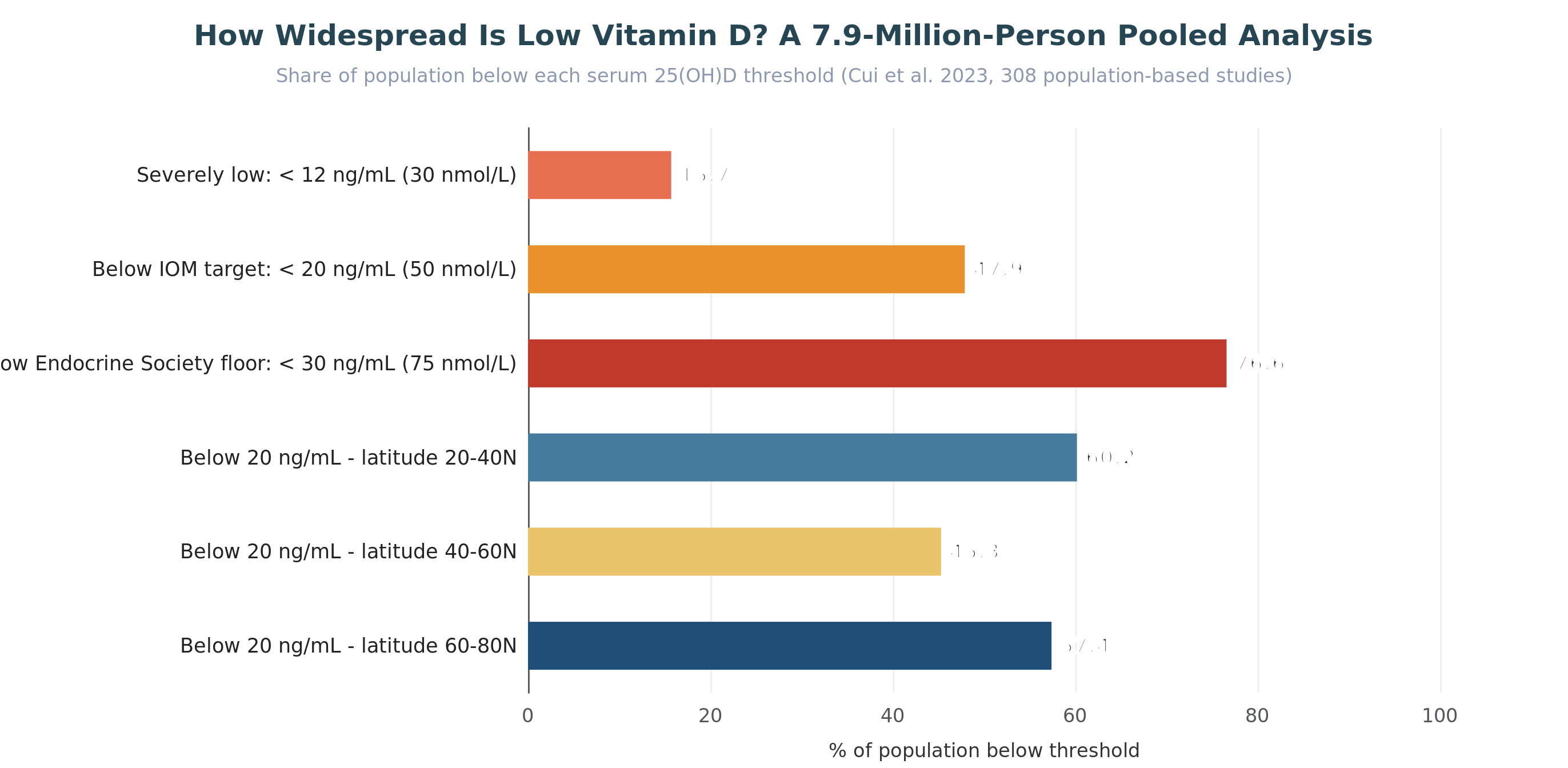
The pattern inside those numbers matters as much as the totals. Prevalence below 50 nmol/L was 60.2% at latitudes 20–40°N — a band containing the southern United States, the Mediterranean, the Middle East, and much of South Asia — and 57.4% at 60–80°N, while the lowest-sunlight months roughly doubled the odds of deficiency (winter-spring prevalence 1.7 times summer-autumn)PubMed. Women were affected more than men (17.8% vs. 13.6% below 30 nmol/L)PubMed. Critically, the burden is not confined to dark northern winters: countries with abundant sunshine — India, Turkey, Iran, and much of the Middle East — show some of the highest deficiency rates in the world, driven by indoor lifestyles, air pollution, clothing practices, and avoidance habits. Sunlight availability, in other words, is not the binding constraint; sunlight exposure behavior is — which is precisely the lever a platform like OPSIN exists to move.
11.2 Who is most at risk#
Certain groups sit far above the global averages. The standard reference summaries identify the elderly, the obese, hospitalized patients, and nursing-home residents as the highest-prevalence groups — with obesity alone associated with about 35% greater prevalence of deficiency, and patients on medical wards showing rates around 57%NCBI Bookshelf. People with chronic kidney disease show the most extreme rates of any group (reported ranges of 85–99%), and dark-skinned individuals at northern latitudes combine low cutaneous synthesis capacity with low ambient UVBNCBI Bookshelf. Infants are a special case: prevalence exceeding 90% has been reported in Iran, Turkey, and India, and because breast milk contains little vitamin D, exclusively breastfed infants without supplementation depend almost entirely on either sunlight or dropsNCBI BookshelfPubMed.
The risk map also intersects directly with modern indoor life. Office workers, shift workers, the institutionalized elderly, and anyone whose daylight exposure happens through window glass are effectively living at an artificially higher latitude all year round. This is the population segment — often young, urban, and sun-avoidant rather than elderly — where deficiency has been rising and where the cultural message of total sun avoidance has done the most damage. The sections that follow examine what that population-level shortfall is associated with, organ system by organ system, distinguishing carefully between what trials have proven, what epidemiology suggests, and what experts believe.
12. The Deficiency–Disease Map: What Low Vitamin D and Low Light Are Linked To#
This section is the heart of the expanded report: a system-by-system survey of the health problems associated with vitamin D deficiency and inadequate light exposure, each graded by evidence strength. The pattern that emerges is remarkable in its breadth — nearly every major organ system appears — but the honesty of the grading matters as much as the breadth. Some links (bone disease, falls, autoimmune disease, respiratory infections) are supported by randomized trials and meta-analyses of trials. Others (dementia, depression, preterm birth, most cancers) rest on observational or Mendelian-randomization evidence of varying strength. A few are expert belief awaiting definitive testing. The figure below anchors the strongest quantitative estimates, and the master table in Section 12.9 consolidates everything.
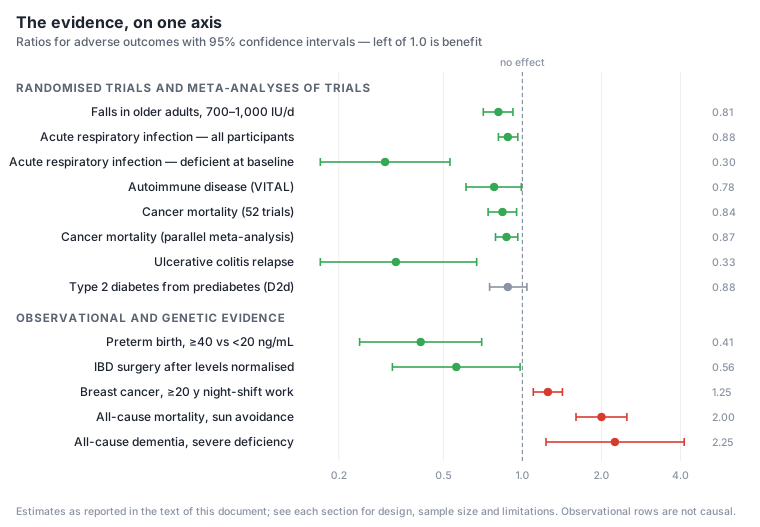
12.1 Bone, muscle, and falls: the original territory — with a modern caution#
This is the one domain where no controversy exists. Vitamin D deficiency causes rickets in children and osteomalacia in adults, contributes causally to osteoporosis, and remains the textbook endocrine deficiency diseaseNCBI Bookshelf. What is less appreciated is how far the skeletal story extends into functional outcomes. A meta-analysis of eight randomized trials found that supplemental vitamin D in the 700–1,000 IU/day range reduced falls in older adults by 19% (RR 0.81, 95% CI 0.71–0.92), while lower doses or achieved levels below 60 nmol/L showed no benefit — falls matter because they are the proximal cause of most hip fractures, and hip fractures in the elderly carry mortality comparable to some cancersPubMed.
The modern caution is equally important for a knowledge base: dose is not linearly "more is better." The STURDY trial, a randomized study specifically in fall-prone adults aged 70+, found that higher daily doses (1,000–4,000 IU) did not reduce falls more than the conventional 200 IU — and the two higher-dose arms showed a higher rate of serious fall-related injuries and fracturesPubMed. Together with the annual-megadose trial that increased falls and fractures in elderly women, this establishes that the vitamin D–falls relationship is likely U-shaped: deficiency is dangerous, restoration helps, and aggressive dosing in already-replete, fall-prone elderly may tip back toward harm. For readers, the lesson maps neatly onto the hormone framing of Section 1: hormones have optimal windows, and exceeding them is not a free lunch.
12.2 Immune defense and respiratory infections: from the 2017 landmark to COVID-19#
The 2017 individual participant data (IPD) meta-analysis by Martineau and colleagues remains the strongest causal evidence that vitamin D status affects infection risk. Pooling the raw data of 10,933 participants from 25 randomized trials, it found that vitamin D supplementation reduced the risk of experiencing at least one acute respiratory infection by 12% overall (adjusted OR 0.88, 95% CI 0.81–0.96) — but among participants who started the trial deficient (below 25 nmol/L), the reduction was 70% (OR 0.30, 95% CI 0.17–0.53)BMJ. Daily or weekly dosing worked; intermittent large boluses did not — a finding with direct product implications, since it suggests the body prefers steady, sun-like delivery rhythms over occasional floods. The protective effect in the deficient subgroup is among the largest effect sizes for any cheap, safe intervention in respiratory medicine, and the authors report a number needed to treat of 33 overall and just 4 (95% CI 3–7) in the deficient subgroup given daily or weekly dosing.
COVID-19 stress-tested this biology in real time, with instructively mixed results. The most-cited positive finding came from a pilot randomized trial in Córdoba, Spain, where hospitalized COVID-19 patients given high-dose calcifediol (the liver's 25(OH)D form) alongside standard care had a 2% ICU admission rate versus 50% in the standard-care group (p < 0.001)PubMed. A subsequent real-world cohort from the same Andalusian hospital system found patients treated with calcifediol had ~87% lower odds of ICU admission (OR 0.13, 95% CI 0.07–0.23) and ~79% lower odds of death (OR 0.21, 95% CI 0.10–0.43)PubMed. Yet large trials of single high-dose cholecalciferol boluses given late in illness found no benefit, and an umbrella review of the COVID-era meta-analyses concluded that low vitamin D is consistently associated with worse COVID-19 outcomes while the evidence that supplementation changes those outcomes remains weak and inconsistentPubMed. The fair summary: deficiency tracks strongly with severe COVID outcomes; rapid repletion with calcifediol looked dramatically effective in Spanish data; and cholecalciferol boluses given late in illness do not reproduce that effect — consistent with the pharmacology, since calcifediol acts within hours while cholecalciferol needs days of hepatic conversion.
12.3 Cancer: the incidence-versus-mortality distinction that resolves the confusion#
The cancer literature appears contradictory until one separates getting cancer from dying of it. On incidence, the large trials (VITAL included) are essentially null: vitamin D does not appear to prevent most cancers from starting. On mortality, the picture is consistently positive. The 2019 BMJ meta-analysis of 52 trials (75,454 participants) found vitamin D supplementation reduced cancer death by 16% (RR 0.84, 95% CI 0.74–0.95), with no effect on all-cause mortality overallBMJ. A parallel Annals of Oncology meta-analysis the same year found a similar 13% reduction (RR 0.87, 95% CI 0.79–0.96)annalsofoncology.org, and a follow-up analysis splitting trials by dosing schedule found the cancer-mortality benefit concentrated in trials using daily dosing rather than intermittent large bolusesNature. The observational side adds the incidence dimension the trials lacked: a pooled analysis of a randomized-trial cohort and a prospective cohort found women with 25(OH)D ≥40 ng/mL had 67% lower risk of all invasive cancers combined than women below 20 ng/mL (HR 0.33, 95% CI 0.12–0.90)PMC.
The mechanistic logic supports the distinction: vitamin D's well-characterized effects on cell differentiation, proliferation restraint, and apoptosis plausibly slow established tumors more than they prevent initiation — and the VITAL finding that benefit appeared after excluding the first one to two years of follow-up fits a slow-acting effect on progression rather than prevention of onset. On specific cancers, the observational gradient is steep: pooled analysis of two cohorts plus a clinical trial found women with 25(OH)D ≥60 ng/mL had 80% lower breast cancer risk than women below 20 ng/mL (HR 0.20, 95% CI 0.05–0.75) — observational, but consistent with decades of latitude studies tracing back to the Garland brothers' original observation that colon and breast cancer mortality maps onto sunlight availabilityPubMedPubMed. Section 14 covers how far beyond the trials the cancer-prevention community's leaders are willing to go.
12.4 Metabolic disease and diabetes: a subgroup story with a genetic twist#
Type 2 diabetes is where the vitamin D hypothesis faced its most rigorous test. The D2d trial randomized 2,423 adults with prediabetes to 4,000 IU/day or placebo and followed them for new-onset diabetes: the hazard ratio was 0.88 (95% CI 0.75–1.04) — a 12% risk reduction that narrowly missed statistical significance overallPubMed. But two prespecified analyses reframed the null. First, in participants who were vitamin D deficient at baseline (below ~12 ng/mL), the reduction was 62% (HR 0.38); second, participants who maintained levels above 50–75 nmol/L during the trial had substantially lower conversion rates regardless of assigned armPubMed. The trial also revealed strong effect modification by body weight: benefit concentrated in participants with BMI under 30, with none in the obese — echoing the obesity-sequestration problem noted in Section 11PubMed.
In 2026, a follow-up genetic analysis of D2d added a remarkable layer: the benefit of vitamin D depended on variants in the vitamin D receptor gene itself. In the ~70% of participants whose VDR genotype predicted more favorable receptor function, supplementation reduced diabetes risk by 19%; in the genetic minority, it did nothing — a finding the investigators framed as a step toward genotype-guided preventionPubMed. Combined with the individual-participant meta-analysis of three trials (showing a pooled 15% reduction, rising to 76% in those maintaining levels ≥50 ng/mL), the metabolic story mirrors the respiratory one: modest average effects masking large effects in the deficient and the biologically responsive. For a calculator-driven platform, this is a mandate for personalization rather than population-average advice.
12.5 Brain and mind: depression and dementia#
The brain expresses both the VDR and the vitamin D–activating enzyme throughout regions involved in mood and cognition, so the epidemiological findings land on plausible biology. On dementia, the evidence has firmed considerably. The landmark prospective study (1,658 elderly adults, Cardiovascular Health Study) found that severe deficiency (<25 nmol/L) was associated with 125% increased risk of all-cause dementia (HR 2.25, 95% CI 1.23–4.13) and 122% increased Alzheimer's risk, while moderate deficiency carried ~50–70% increasesPubMed. A UK Biobank analysis combining observational and Mendelian-randomization methods extended this: low vitamin D was associated with substantially elevated dementia and stroke risk in the cohort data, and the genetic analysis supported a causal contribution of deficiency to dementiaPubMed. A 2025 dose-response meta-analysis of observational studies confirmed a graded, non-linear relationship in which risk rises steeply as levels fall below the sufficient rangePubMed. Randomized prevention trials do not yet exist; the evidence is cohort-plus-genetic, which is the strongest observational tier short of an RCT.
Depression presents a genuinely two-sided picture that a knowledge base should present honestly. Meta-analyses of randomized trials have repeatedly found that vitamin D supplementation reduces depressive symptoms, with the strongest effects in people who are deficient or clinically depressed at baselinePubMed. Yet VITAL-DEP — the depression ancillary study of the largest vitamin D trial — found no benefit on depression onset or mood scores over five years in its generally vitamin D–replete population. A 2024 Mendelian-randomization study threaded the needle: it found evidence for a threshold (non-linear) causal effect of vitamin D on depression concentrated in the deficient range, meaning supplementation helps people who start low and does little for people already sufficientPubMed. That threshold logic reconciles the positive meta-analyses with the VITAL null, and it matches the pattern seen in respiratory infections and diabetes: vitamin D behaves like a deficiency-correcting hormone, not a universal mood supplement. For the light side of mood, see Section 13.1 — where the trial evidence for bright-light therapy is stronger than for the pill.
12.6 Autoimmune disease, part two: the inflammatory bowel connection#
Section 4.3 and Section 9 established the multiple sclerosis evidence and VITAL's autoimmune result; the inflammatory bowel diseases (Crohn's disease and ulcerative colitis) add a second autoimmune frontier with a direct gut mechanistic link through the VDR–microbiome axis of Section 7. The epidemiology is consistent: 60–70% of IBD patients are vitamin D insufficient, and deficiency at diagnosis is prospectively associated with more active disease and worse quality of lifePubMed. In prospective cohort data from a major IBD center (3,217 patients), Crohn's disease patients with 25(OH)D below 20 ng/mL had 1.76 times the odds of subsequent surgery (95% CI 1.24–2.51) and 2.07 times the odds of hospitalization (95% CI 1.59–2.68) compared with those at 30 ng/mL or above; and patients whose measured level normalized over follow-up subsequently had 44% lower odds of surgery (OR 0.56, 95% CI 0.32–0.98) than those who stayed low — findings the investigators describe as consistent with vitamin D being an important determinant of long-term outcomes in IBDPubMed.
Intervention data, while smaller than the autoimmune mega-trials, point the same direction. A meta-analysis of randomized trials in ulcerative colitis found vitamin D supplementation reduced clinical relapse by 67% (OR 0.33, 95% CI 0.17–0.67)PubMed. The mechanistic chain is unusually complete for this disease: VDR deficiency worsens experimental colitis in animals; vitamin D induces the antimicrobial peptide cathelicidin in intestinal epithelium; deficiency loosens the tight junctions that keep luminal bacteria separated from immune tissue; and UVB-driven vitamin D measurably shifts the gut microbiome toward butyrate-producers within a week (Section 7.1). IBD may be the disease where the light–vitamin D–microbiome–immunity quadrangle of this entire report converges most tightly.
12.7 Chronic pain and fibromyalgia: promise, mixed trials, honest uncertainty#
Musculoskeletal pain is one of the most commonly reported symptoms of severe vitamin D deficiency — osteomalacia classically presents with diffuse aching — and deficiency is strikingly prevalent in chronic-pain and fibromyalgia clinics, with some reviews reporting insufficiency in a majority of fibromyalgia patientsPubMed. A systematic review and meta-analysis pooling the randomized trials concluded that vitamin D supplementation produces a moderate, statistically significant reduction in fibromyalgia pain, and a separate RCT that specifically repleted deficient fibromyalgia patients found meaningful improvements in pain and functionPubMed. The 2024 Mendelian-randomization work on pain thresholds adds biological credibility to deficiency-level causalityPubMed.
The honest counterweight is that trial results are inconsistent: the meta-analytic literature itself notes substantial heterogeneity between studies, and not every randomized trial separates from placeboPubMed. The most defensible position mirrors the depression literature — repletion likely helps the deficient subset of pain patients, is not a general analgesic, and should be framed as correcting a contributing factor rather than treating the pain itself. For a knowledge base, this is a useful teaching example of why "associated with" and "treats" are different claims, and why the baseline-deficiency question dominates the interpretation of nearly every vitamin D trial.
12.8 Pregnancy and early life: some of the largest effect sizes in the entire literature#
If any single subsection justifies the "levels matter far above 20 ng/mL" argument, it is this one. In the largest combined analysis of two South Carolina pregnancy cohorts (1,064 women, ~90% receiving 4,000 IU/day), women maintaining 25(OH)D of 40 ng/mL or more had a ~60% lower risk of preterm birth than women below 20 ng/mL (OR 0.41, 95% CI 0.24–0.70), and the risk gradient continued to improve beyond 40 ng/mL with no evidence of harmPubMed. In the randomized trial embedded in that program, 4,000 IU/day outperformed 400 and 2,000 IU/day; and among women with a previous preterm birth — the highest-risk group — achieving ≥40 ng/mL was associated with an ~80% reduction in recurrent preterm birthPubMed. Preterm birth is the leading cause of neonatal mortality worldwide, so even a fraction of this effect, if causal, would represent a public-health impact rivaling any established prenatal intervention.
The caveat, stated plainly: these are post-hoc and observational analyses within a supplementation program, not a placebo-controlled preterm-birth trial — randomizing pregnant women to deficiency-risking placebo arms is ethically fraught, which is precisely why this evidence tier may be the best the field ever gets. Beyond preterm birth, deficiency in pregnancy is associated with preeclampsia, gestational diabetes, bacterial vaginosis, and low birth weight in observational syntheses, and early-life deficiency is associated with later respiratory infections, wheeze, and — in ecological and latitude studies — higher multiple sclerosis risk decades later. The Endocrine Society's 2024 guideline, for all its conservatism elsewhere, does recommend above-RDA supplementation in pregnancy, citing reductions in preeclampsia, gestational diabetes, and preterm birth seen in trial dataPubMed. Early life is also where the light-exposure literature (myopia prevention, Section 8.1) and the vitamin D literature overlap most concretely: childhood is the one life stage with proven, randomized, light-based disease prevention already deployed at scale.
12.9 The master condition map#
The table below consolidates every condition in this report — both the newly added and the previously covered — into a single reference, with the dominant pathway and an honest evidence grade, using the tiers defined in "How to read this" at the top: A = randomized trials or meta-analyses of trials show benefit; B = strong observational or genetic evidence, no definitive trial; C = preliminary or mixed evidence. No row here is graded E: the expert positions that outrun the trials are quarantined in Section 14 rather than mixed into this table.
| Condition / health problem | Primary light-linked pathway | Key evidence | Grade |
|---|---|---|---|
| Rickets / osteomalacia | UVB → vitamin D → calcium absorption | Defining deficiency diseaseNCBI Bookshelf | A (established) |
| Osteoporosis & fractures | Vitamin D–calcium–bone axis | Supplementation + calcium reduces fractures in deficient elderly | A |
| Falls in older adults | Vitamin D → muscle/mitochondrial function | 19% reduction at 700–1,000 IU/d; U-shaped at high dosesPubMedPubMed | A (with dose caution) |
| Acute respiratory infections | VDR → cathelicidin, immune modulation | IPD meta-analysis: −12% overall, −70% if deficientBMJ | A |
| COVID-19 severity | Same + calcifediol rapid repletion | ICU admission 2% vs 50% (pilot RCT)PubMed; umbrella reviewPubMed | B/C (contested) |
| Cancer mortality | Vitamin D → cell-cycle restraint, apoptosis | −15% in 52-trial meta-analysisBMJ | A (mortality only) |
| Cancer incidence (breast, colorectal) | Vitamin D + latitude/UV ecology | −80% breast cancer at ≥60 vs <20 ng/mL (obs.)PubMed | B |
| Type 2 diabetes (from prediabetes) | VDR in pancreas/muscle; insulin sensitivity | D2d: −12% overall (NS), −62% if deficientPubMed | B |
| Cardiovascular disease / hypertension | UVA → nitric oxide; VDR–renin | BP reduction via skin NOPubMed; VITAL CVD null | B (mechanism) / A-null (pills) |
| Multiple sclerosis | UV → immune tolerance + vitamin D | Latitude gradient; OR 0.24 outdoor work; only ~30% via vitamin DPubMedPubMed | B |
| Autoimmune disease (overall) | VDR → immune regulation | VITAL RCT: −22%, −39% with sustained exposurePubMed | A |
| Inflammatory bowel disease | VDR–barrier–microbiome axis | −67% relapse with supplementation (meta)PubMed; surgery odds 1.76× if <20 vs ≥30 ng/mL; normalizing levels → surgery OR 0.56PubMed | B |
| Rheumatoid arthritis | Immune modulation | Included in VITAL autoimmune composite; observational links | C |
| Depression | VDR in brain; circadian light | Threshold causal effect in deficiency (MR)PubMed; VITAL null in replete | B/C |
| Seasonal affective disorder | Circadian/melanopsin pathway | Light therapy: 61% vs 32% response vs placebo controlPubMed | A (light, not pills) |
| Non-seasonal major depression (adjunct) | Bright light therapy | 41% vs 23% remission (2024 meta-analysis)PubMed | A (light) |
| Dementia / Alzheimer's | VDR neuroprotection; deficiency toxicity | HR 2.25 severe deficiencyPubMed; MR supportPubMed | B |
| Chronic pain / fibromyalgia | Vitamin D–muscle/nerve | Meta-analysis positive; individual RCTs mixedPubMed | C |
| Preterm birth | Vitamin D endocrinology of pregnancy | ≈59% lower odds at ≥40 vs <20 ng/mL (OR 0.41)PubMed | B |
| Preeclampsia / gestational diabetes | Placental VDR signaling | Trial-informed guideline endorsementPubMed | B |
| Childhood myopia | Bright light → retinal dopamine | School RCTs: ~23% relative reduction in incident myopia (Guangzhou); replicated with light-intensity dosingPubMedPubMed | A |
| Gut dysbiosis | UVB → skin–gut axis | UVB increased diversity in 1 weekFrontiers | C |
| All-cause mortality | All pathways combined | Sun avoidance ≈ smoking-level risk (cohort)PubMedPubMed | B |
| Breast cancer (night work) | Circadian disruption → melatonin suppression | IARC 2A; HR up to 2.15 in young night workersWHOPubMed | B |
| Sleep quality / duration | Melatonin timing; VDR in sleep centers | Evening light suppresses melatonin 71%PMC | A (light timing) |
Two honest observations complete the map. First, notice the asymmetry: conditions where trials enrolled deficient people or measured achieved levels (respiratory infections, diabetes subgroups, falls) tend to show strong effects, while trials that dosed unselected populations (VITAL's primary endpoints, depression) tend to nulls — the strongest argument that the exposure being tested should be deficiency correction, not supplementation per se. Second, the map's breadth is itself evidence of system-level importance: no ordinary nutrient touches bone, immunity, brain, metabolism, pregnancy, and gut simultaneously — but a hormone regulating 3% of the genome, layered on a circadian system regulating roughly half of all genes on a daily cycle, plausibly can.
13. New Frontiers of Light: Domains Beyond Vitamin D#
13.1 Seasonal affective disorder and bright-light therapy: light as an actual antidepressant#
The most clinically established light intervention in all of medicine is not a supplement — it is a lamp. Seasonal affective disorder (SAD) is a recurrent winter depression tied to shortened photoperiods, and bright-light therapy (typically 10,000 lux for ~30 minutes each morning) has been tested against placebos and drugs for four decades. In the classic randomized trial by Eastman and colleagues, morning bright light produced a treatment response in 61% of SAD patients, versus 50% with evening light and 32% with a plausible placebo (a deactivated negative-ion generator)PubMed. In the Can-SAD trial, light therapy proved as effective as fluoxetine (Prozac) for SAD, with a comparable remission profile and faster onset of actionPubMed. Across the SAD literature, response rates cluster in the same 40–60% range as antidepressant medication — for a condition caused, in essence, by insufficient light.
The bigger story is that the indication is escaping its seasonal box. A 2024 meta-analysis in JAMA Psychiatry pooling randomized trials of bright-light therapy for non-seasonal depressive disorders found remission rates of 41% versus 23% and response rates of 60% versus 39% for light versus control conditions — significant, clinically meaningful, and additive to standard treatmentPubMed. For the OPSIN knowledge base, this literature is the single most persuasive demonstration that light is a legitimate therapeutic input, not a wellness metaphor: a condition of light deficiency, diagnosed by season, treated with photons, validated against drugs in randomized trials. It also reframes the everyday question — if 10,000-lux mornings can treat clinical depression, what is the subclinical cost of spending every morning under 300-lux office lighting?
13.2 Light at night and cancer: the WHO's "probable carcinogen" most people have never heard of#
In 2007, the International Agency for Research on Cancer (IARC — the WHO's cancer classification body) classified shift work that involves circadian disruption as a Group 2A carcinogen: "probably carcinogenic to humans" — the same category as glyphosate and hot beverages above 65°C — and reaffirmed the classification in its 2019 re-evaluation of night-shift work, citing sufficient evidence in experimental animals and strong mechanistic evidence in humansWHOPubMed. The mechanism runs directly through the biology of Section 6: light at night suppresses melatonin, and melatonin has oncostatic (cancer-restraining) properties; circadian disruption simultaneously desynchronizes the cell-cycle and DNA-repair genes that peripheral clocks regulate.
The human epidemiology that drove the classification centers on breast cancer in night workers. In the Nurses' Health Study, the original 2001 analysis reported 36% elevated breast cancer risk with 30 or more years of rotating night work (RR 1.36, 95% CI 1.04–1.78)PubMed; the extended 2017 follow-up complicated the picture, finding no excess in the original cohort's longest-exposure group (HR 0.95) but a strong association in the younger second cohort, where premenopausal women with 20+ years of rotating shifts at baseline carried HR 2.15 (95% CI 1.23–3.73) — a between-cohort heterogeneity the authors could not fully explainPubMed. A 2025 meta-analysis focused specifically on healthcare workers found 25% elevated breast cancer risk with ≥20 years of night work (RR 1.25, 95% CI 1.10–1.42) with a significant dose-response per decade of exposurePubMed. The IARC working group also noted positive associations with prostate and colorectal cancers, while emphasizing that the human evidence remains "limited" — a genuine but not airtight case, graded accordinglyWHO. This is the dark-side bookend of the OPSIN thesis: light is information, and delivered at the wrong time it becomes misinformation with a measurable signature in cancer epidemiology.
13.3 The skin–brain reward axis: why sunlight literally feels good#
A discovery that deserves far more public attention explains a universal human experience — why a sunny day is mood-lifting within minutes, long before any vitamin D could be synthesized. In 2014, Fell and colleagues demonstrated in Cell that UV exposure causes keratinocytes (skin cells) to produce and release β-endorphin — an endogenous opioid — via the p53 tumor-suppressor pathway, raising blood endorphin levels enough to produce measurable analgesia and opioid-receptor-mediated reward responses in micePubMed. The response was strong enough to be addictive: chronic low-dose UV-exposed mice showed classic opioid dependence signs, reversed by naloxone. Human confirmation followed: narrowband UVB exposure induces β-endorphin expression in human skin in vivoPubMed.
The evolutionary interpretation, argued by the discoverers and developed by skin-neuroendocrinology pioneer Andrzej Slominski, is that the endorphin reward is a behavioral adaptation to drive UV-seeking — nature's way of making the vitamin D–synthesizing behavior feel good, ensuring organisms exposed themselves enough to secure the hormonePubMedPubMed. Slominski's broader body of work documents that skin operates as a true neuroendocrine organ, producing not only endorphins but cortisol, serotonin-pathway molecules, melatonin, and its own local vitamin D activation machinery in response to UVPubMed. For a platform encouraging people outdoors, this is the feel-good mechanism that makes the behavior self-reinforcing — sunlight is engineered by evolution to be rewarding — and it completes the mood picture alongside circadian light (Section 13.1) and vitamin D's neural effects (Section 12.5). One caveat fits the report's safety frame: the same reward loop plausibly contributes to tanning dependence, which is precisely why the knowledge base should teach dose discipline rather than maximal exposure.
14. Expert Voices: Firm Positions Beyond the Trial Evidence#
Everything in this section is labeled expert opinion: these are clearly stated beliefs of notable, credentialed researchers that go beyond — sometimes well beyond — what randomized trials have proven. They are included because these scientists shaped the field and their reasoning is instructive, but readers should hold them to a different standard than the graded evidence above.
14.1 Michael Holick — the field's most prominent advocate#
Michael Holick (Boston University) is arguably the most influential vitamin D researcher alive — he isolated the active form of the hormone, wrote the Endocrine Society's 2011 guideline, and has published hundreds of papers on the subject. His stated positions go considerably further than any guideline. In the American Journal of Clinical Nutrition he declared that "vitamin D deficiency is now recognized as a pandemic," attributing it to "the lack of appreciation that sun exposure in moderation is the major source of vitamin D for most humans"PubMed — a position he has since developed into detailed arguments for sensible, non-burning sun exposure as a public-health measure, challenging what he sees as dermatology's counterproductive zero-exposure messagingPubMed. He has called vitamin D deficiency "probably the most common medical issue worldwide," estimating a billion people — "maybe even half the world's population" — deficient or insufficient, "and the reason is simple. Our major source of vitamin D is sunlight, and we are no longer out in the sun". On targets, he maintains that 30 ng/mL (75 nmol/L) is the minimum for maximizing health benefits, with 800–1,000 IU/day or more needed in the absence of adequate sun exposurePubMed — and his clinical dosing recommendations for high-risk deficient patients run far higher than official RDAs — positions he states as firm clinical conviction, presented here as expert opinion rather than trial-proven guidance.
These are the views of a giant of the field, stated repeatedly in peer-reviewed venues, but they are still individual judgment calls about where the evidence points, not trial-established facts. The strongest parts of Holick's case (the pandemic scale, the self-limiting safety of sun-derived production) are well supported by the prevalence data in Section 11 and the photochemistry in Section 10. The boldest parts (high-dose supplementation practice) rest on his interpretation of the toxicity literature and should be read as such — particularly given the STURDY trial's signal that high doses may harm fall-prone elderlyPubMed.
14.2 Cedric Garland — vitamin D as the "main known cause" of breast cancer#
The late Cedric Garland (UC San Diego) co-founded the sunlight–cancer hypothesis with his brother Frank in 1980, after noticing that colon cancer mortality maps onto latitude. His later positions were strikingly direct. He argued publicly that most breast cancer is preventable, that vitamin D deficiency is its main known cause, and that raising population 25(OH)D to 40–60 ng/mL could prevent the large majority of cases. We state his position rather than quote it: the widely circulated 2009 open letter to the New York Times in which he put it most bluntly survives only in an archive maintained by the nonprofit he co-founded, and a claim this strong should rest on the peer-reviewed record instead — which, in his case, it can. A 2009 modeling study in the Annals of Epidemiology projected that raising population levels to 40–60 ng/mL could prevent approximately 58,000 breast cancer and 49,000 colorectal cancer cases annually in the US and Canada, cutting deaths from those diseases by three-quartersPubMed. His dose calculations were correspondingly aggressive: an analysis of 3,667 supplemented adults found some individuals required up to 10,000 IU/day to reach cancer-preventive levels, with genetics driving much of the variationPubMed.
Garland's projections are ecological-model extrapolations — mathematically rigorous, but built on observational gradients, and they exceed anything the randomized trials have demonstrated for cancer incidence (which, per Section 12.3, the trials have not shown). The mortality evidence does lean in his direction, and his high-target position draws support from the breast-cancer pooled analysis he co-authored, in which women above 60 ng/mL had one-fifth the breast cancer risk of women below 20 ng/mLPubMed. But "main known cause of breast cancer" is firmly in expert-belief territory, and the knowledge base should present it there — as a serious hypothesis from the hypothesis's originator, not as established prevention advice.
14.3 The photobiology school: Weller, Jeffery, and the spectrum argument#
Two researchers anchor the "sunlight is more than vitamin D" position with mechanistic authority. Richard Weller (University of Edinburgh) argues, based on his nitric oxide work and the cardiovascular epidemiology, that public-health guidance has been one-sided: sunlight's mortality benefits in low-sun countries plausibly outweigh its skin-cancer risks, and the cardiovascular effects of sun exposure are independent of vitamin D and therefore unreachable by supplementation (Section 4.2)PubMed. Glen Jeffery (UCL) extends the argument to the metabolic system: modern indoor spectra are "red-starved," chronic blue-weighted light "can drive disrupted blood sugars that may in the long run contribute to diabetes and undermine health spans," and the deficit "can partly be corrected by spending more time in sunlight" (Section 5.2). Andrzej Slominski adds the neuroendocrine dimension: the skin is a peripheral neuroendocrine organ whose UV-triggered outputs (endorphins, serotonin-pathway molecules, local vitamin D activation) mean sunlight acts on brain and mood through channels no capsule replicatesPubMed.
These three positions share a structure worth naming: each identifies a specific, demonstrated, vitamin D–independent mechanism, then argues that population guidance built only on skin-cancer risk systematically ignores it. The mechanisms are trial-grade or near it; the population-level extrapolations ("outweighs the risks") are expert judgment. Presenting them as such lets readers see both the strength of the science and the exact point where it becomes advocacy — and it is worth noting that mainstream bodies increasingly echo the milder version (the UK Health Security Agency now runs a research program on sunlight and cardiovascular health).
14.4 The strongest case against: what the sceptics actually argue#
A knowledge base that presents Holick, Garland, and Weller without their most credible opponents would be advocacy, not education. The sceptical position in this field is not fringe — it is held by senior epidemiologists at major institutions, and in several places it has the better of the current trial record. It deserves presentation at full strength.
The marker-of-ill-health hypothesis. The most consequential sceptical argument belongs to Philippe Autier (formerly IARC, International Prevention Research Institute), whose systematic review in The Lancet Diabetes & Endocrinology laid out the case that low 25(OH)D is predominantly a consequence of ill health rather than a cause: the observational associations are real, but the direction of causation is backwards, and randomized trials have largely failed to deliver the benefits the associations promisedPubMed. Two mechanisms give this argument teeth rather than hand-waving. First, 25(OH)D behaves as a negative acute-phase reactant: Waldron and colleagues showed that levels fall measurably during systemic inflammatory illness, which means people who are already sick reliably test "deficient" whether or not deficiency caused anythingPubMed. Second, Drincic and colleagues demonstrated volumetric dilution: 25(OH)D concentration tracks inversely with body size and plasma volume, so a substantial part of the obesity–deficiency association is arithmetic, not biologyPubMed. If even part of the observational edifice is reverse causation plus dilution, the true causal effects are smaller than the cohort gradients suggest — and the moderate trial results are what an honest Bayesian would expect.
The pessimistic reading of the trial record. Bolland, Grey, and Avenell (University of Auckland) have argued, across a series of meta-analyses and editorials, that the aggregated randomized evidence shows at most small, clinically marginal effects for most non-skeletal outcomes, that existing trials are "unlikely to alter" the conclusions, and that further mega-trials of unselected supplementation are a poor use of resourcesPubMed. Their reading is not cherry-picked. VITAL's fracture ancillary, published in the New England Journal of Medicine, found that 2,000 IU/day did not reduce total, non-vertebral, or hip fractures in healthy mid-life and older adults — HR 0.98, null even in subgroup analysesPubMed. VITAL-DEP found no effect on depression onset or mood over five years. D2d's primary endpoint missed significance (HR 0.88, 95% CI 0.75–1.04)PubMed. STURDY found higher doses did not outperform 200 IU/day for falls and signalled more serious fall injuries in the high-dose armsPubMed. Weighted by size, registration, and rigor, the null results are the center of mass of the modern trial record — and the positive findings cluster in subgroup, post-hoc, and achieved-level analyses, exactly the analytic territory where false positives live.
The genetic-epidemiology record cuts both ways — and so does the bias literature. Mendelian randomization was supposed to settle causality, and it has not delivered the clean win either side hoped for: standard (linear) MR analyses have failed to confirm causal effects of 25(OH)D on several outcomes where observational links were strongest, including cardiovascular endpoints, while the newer non-linear MR methods that do find effects find them only as threshold phenomena in the deficient range — for dementiaPubMed and depressionPubMed — which is a far narrower claim than "higher is better for everyone." The bias critique is equally live. The umbrella review of COVID-era meta-analyses found the association literature consistent but rated the supplementation evidence as very low quality, cautioning against clinical conclusionsPubMed; and the field's most dramatic positive trial — the Córdoba calcifediol pilot, n = 76, ICU admission 2% versus 50%PubMed — is precisely the kind of small, single-center, implausibly large effect that trialists are trained to discount until replicated, especially when larger bolus trials found nothing.
Why this document nonetheless does not conclude "case closed." Each sceptical argument has a documented counterpoint, and intellectual honesty requires listing them alongside rather than after the fact. The trials the sceptics weigh most heavily dosed unselected, largely replete populations at fixed amounts — they tested supplementation, not deficiency correction, and the deficiency-subgroup signals (respiratory infections −70%, D2d −62%, the VDR-genotype interaction) sit in the same trials the sceptics citeBMJPubMedPubMed. The marker hypothesis cannot easily explain randomized effects confined to deficient subgroups, nor interventional UVB effects on the microbiome and mitochondrial endpoints; volumetric dilution explains obesity gradients but not trial subgroup structure. The daily-versus-bolus pharmacology — now vindicated in cancer-mortality meta-analysisNature — means several landmark nulls may be dose-schedule artifacts rather than proof of no effect. And the acute-phase argument cuts hardest against cross-sectional studies, not against prospective cohorts with levels measured years before disease. The defensible synthesis is uncomfortable for both camps: the truth probably lies between "pandemic hormone deficiency that explains chronic disease" and "an expensive biomarker of being unwell," and the decisive experiment — a large trial that enriches for deficiency, titrates to achieved level, and uses daily dosing — has still never been run. Until it is, OPSIN's knowledge base will keep both readings visible, which is why this section exists at all.
14.5 How to read expert opinion on this platform#
The inclusion of expert positions follows three rules that the OPSIN knowledge base can adopt as editorial policy. First, attribution and labeling: every opinion is tied to a named researcher, their institution, and the explicit caveat that it extends beyond trial proof. Second, mechanism anchoring: opinions are included only when attached to a documented line of evidence (Holick's prevalence data, Garland's latitude gradients, Weller's NO pathway) — not free-floating authority claims. Third, counterpoint inclusion: where the mainstream disagrees (the 2024 Endocrine Society guideline against Holick; dermatology guidance against Weller), the counterpoint appears alongside, already covered in Sections 2, 4.2, and 10.3. Presenting firm expert belief with a clear flag on it doubles as a trust feature: a resource that shows its evidence grading on every claim is harder to dismiss than one that asserts.
15. Synthesis: The Whole Map in One Picture#
Taken together, the expanded evidence reframes the original OPSIN premise from "sunlight gives you vitamin D, which is good for you" into something larger and more precise: humans run on light the way they run on food, with at least five partially independent input channels — the vitamin D hormone system (UVB), the cardiovascular nitric-oxide system (UVA), the circadian timing system (blue-weighted visible light, through melanopsin), the mitochondrial energy and antioxidant system (red and near-infrared), and the skin's own neuroendocrine outputs (endorphins and related molecules) — plus the non-optical benefits of outdoor environments themselves. Each channel has its own deficiency syndrome: rickets and the disease map of Section 12 for the first; the cardiovascular and mortality epidemiology for the second; SAD, circadian misalignment, and the shift-work cancer data for the third; the emerging metabolic and aging findings for the fourth; and the mood-reward dimension for the fifth.
The modern indoor environment degrades all five channels simultaneously, which is why the disease map is so broad and why single-molecule interventions keep underperforming the behavioral exposure. The practical corollaries are stable across sections: correct deficiency rather than supplement indiscriminately; prefer daily, moderate, sun-like rhythms over boluses; protect the dark half of the cycle as seriously as the light half; personalize by latitude, skin, age, and now genotype; and grade every claim by its evidence tier. That synthesis — five channels, one behavior, honest grading — is the intellectual spine the OPSIN knowledge base can be built on, and it is a formulation no competing resource currently offers in one place.
16. What Science Has Not Yet Answered#
16.1 What science has not yet answered#
A knowledge base that maps open questions is as valuable as one that summarizes answers, because it inoculates readers against overclaiming elsewhere. The significant gaps: whether free/bioavailable 25(OH)D predicts health outcomes better than total 25(OH)D in prospective trials (strong mechanism, thin outcome data)PMC; whether mitochondrial melatonin induction by NIR translates into clinical benefits in humans (biochemistry solid, human trials absent)PMC; whether OPN3/OPN5 pathways function meaningfully in human physiology (established in mice, unproven in humans)PMC; the true dose-response of photobiomodulation across wavelengths, tissues, and schedules, given its biphasic curvePubMedPubMed; whether the mortality associations of sun exposure survive full causal analysis (observational to date)PubMed; and the mechanism chain linking UVB, vitamin D, and specific gut-microbiome functions beyond the pilot stageFrontiers. The 2024 Endocrine Society controversy also leaves the practical question — what to tell an individual with a measured level — officially unansweredMDPIFrontiers.
The expanded edition adds a second tier of open questions. No randomized trial has yet tested vitamin D for dementia prevention, leaving the HR-2.25 association short of causal certaintyPubMed; the preterm-birth findings, among the largest effect sizes in the literature, come from post-hoc analyses rather than a purpose-built placebo trial — one that may never be ethically possiblePubMed; whether bright-light therapy's depression efficacy extends to general-population mood and productivity at subclinical levels is untestedPubMed; the β-endorphin UV-reward system has been confirmed in humans only for phototherapy-dose UVB, not everyday sunlightPubMed; the shift-work–breast-cancer link, though IARC-classified, still lacks a demonstrated intervention (does better light hygiene protect night workers?)WHO; and the VDR-genotype personalization signal from D2d awaits replication before genotype-guided dosing can be recommendedPubMed. The COVID-19 calcifediol findings likewise await confirmation in large, multi-center trials before their dramatic effect sizes can be treated as settledPubMedPubMed.
There is also a measurement gap that OPSIN is uniquely positioned to notice: nearly every pathway in this report is governed by personal and environmental variables — latitude, season, skin type, age, clothing, schedule — yet nearly all public guidance is written as population averages. The myopia trials succeeded partly because they measured light with wearables rather than asking about itPubMed, and the vitamin D field's fiercest disagreements trace back to heterogeneous dose-response across individualsPMC. Personalized light-exposure estimation is not a convenience feature; it is the methodological fix the science itself keeps calling for.
16.2 How this document handles its sources#
Three standing rules, stated once so that individual citations do not have to argue for themselves.
Primary sources for findings. Every number in this document is cited to the publication that reports it. Press releases, news coverage, trade press, advocacy blogs and commercial pages are not used as the source of a finding; where earlier drafts relied on them, they were replaced.
Quotes are cited to where they were said. When a named researcher's opinion is the subject — Section 14 is built out of them — the citation points to the interview, university announcement or expert-reaction roundup in which they said it, because that is the source of record for a statement of belief. Those citations carry no numeric findings, and their status as opinion is labelled in the paragraph itself.
Corrections are published, not quietly absorbed. If you find an error — a misread figure, a mis-attributed study, a claim since overturned — we would rather hear it: [email protected]. Substantive corrections are logged in the revision note at the top of this document.
Disclaimer: This report was compiled for general informational and educational purposes only. It synthesizes published research and does not constitute medical advice, diagnosis, or treatment. Vitamin D supplementation, sun exposure, and light-therapy decisions should be made with a qualified healthcare professional who can account for individual medical history, medications, skin type, and risk factors. Where the scientific literature is contested — as it is on optimal vitamin D levels and sun-exposure guidance — this report presents the competing positions rather than resolving them.
(Science Media Centre expert-reaction roundup; used for verbatim expert commentary only, no numeric findings) (UKHSA institutional page; cited only for the existence of its research programme, not for any numeric finding) (university news coverage; retained only for verbatim Jeffery quotes — numeric findings are cited to the primary studyPubMed) (Holick's personal website; statements of his own positions, quoted as expert opinion)