What UV index do you need for vitamin D?
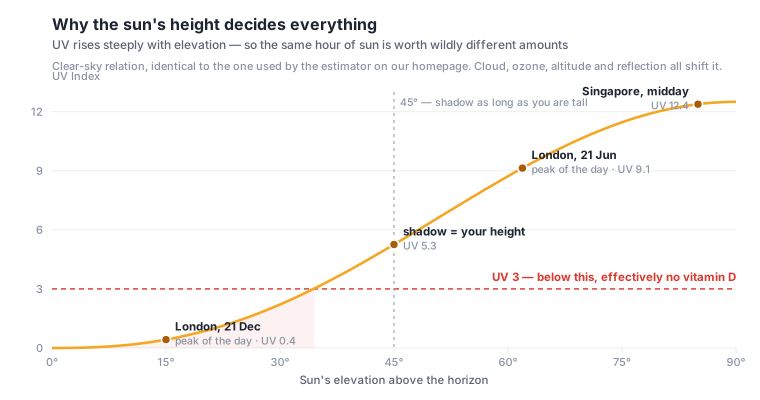
Short answer: roughly UV Index 3 or above. Cutaneous vitamin D synthesis requires UVB at sufficient intensity, and a UV Index of about 3 is the conventional working thresholdLinus Pauling Institute. Below it there is little useful UVB reaching the ground — no matter how bright or how warm the day feels.
Why there's a threshold at all
UVB is the shorter, higher-energy end of ultraviolet, and the atmosphere removes it far more aggressively than it removes UVA. The lower the sun sits, the longer the path its rays take through that atmosphere — so UVB falls away much faster than total UV or than the warmth you feel on your skin. Past a certain sun angle, essentially all of it is gone before it reaches you.
That's why the threshold shows up as a seasonal and daily pattern rather than a weather one. At around 40° latitude — Boston sits at 42°N — there is effectively no vitamin D synthesis from November to early March. At Edmonton's latitude the "vitamin D winter" runs October through AprilLinus Pauling Institute. We cover that season in the winter guide.
The shadow rule: checking it without an app
There's a field test that needs no instrument. UVB is usually sufficient once the sun is higher than about 45° above the horizon — and that happens to be exactly the moment your shadow becomes shorter than you are tallPubMed.
- Shadow shorter than you — sun high, UVB likely sufficient.
- Shadow longer than you — sun low, little to no vitamin D on offer.
In practice this puts the productive window around the middle of the day, roughly 11:00–15:00 in summer, and it explains why the same 15 minutes is worth far more at noon than at 5 pm.
How much difference does it actually make?
A modelling study for Hannover (52°N) put numbers on it. The skin time needed to synthesise 1,000 IU ranged from 1.1 minutes on 21 June to 39 minutes on 21 December under clear skies — and was effectively impossible under December cloudNature. A separate analysis found tropical latitudes needing only 3–6 minutes, while Boston in winter produced effectively nothing at any practical exposurePubMed.
Those are modelled figures for specific skin types and exposed areas, not personal prescriptions — but the spread is the point. The same behaviour can be worth thirty-five times more or nothing at all.
Where the UV index misleads
- It's weighted for sunburn, not vitamin D. The UV Index is an erythema-weighted number; the vitamin-D action spectrum is different. Careful models compute the vitamin-D response through an atmospheric transfer model rather than using erythema-weighted shortcutsNature. Treat the index as an availability signal, not a dose.
- Cloud is not neutral. Heavy cloud can halve or eliminate effective UVBPubMed — bright overcast is not the same as productive.
- Glass cancels it entirely. UVB does not pass ordinary window glass, so a sunny desk yields about zero vitamin DLinus Pauling Institute.
- Reflection and altitude raise the real dose. Snow, sand, water and concrete bounce UV upward, and intensity climbs with altitude — the same index number burns faster on a ski slope than in a gardenWHO.
- A high index is also a burn risk. The number that makes vitamin D possible is the same number that makes burning possible — see sunscreen and vitamin D for how to hold both.
What to do with the number
- Under UV 3: take the light for your body clock, don't expect vitamin D. In a genuine vitamin D winter, that's a supplement conversation with a clinician.
- UV 3 and above: vitamin D is available. How much depends on your skin tone, bare surface area and age — see how much sun you need.
- High UV: the productive window is short and the burn window is shorter. Synthesis plateaus well before you redden; extra time adds risk, not vitamin D.
The full treatment, with an evidence grade on every claim, is in §10.1 of our review.