Vitamin D supplements vs sunlight: are they the same?
Short answer: for your blood level, yes — a supplement works, and it's the right tool when UVB isn't available. For everything else sunlight does, no. The comparison people usually make ("can I just take a pill instead?") quietly assumes vitamin D is the only thing sunlight delivers. It isn't.
What the largest trial actually found
Any honest answer has to start with VITAL, the biggest vitamin D trial ever run: 25,871 U.S. adults randomised to 2,000 IU/day of vitamin D₃ or placebo for a median 5.3 yearsPubMed. On its primary endpoints — total invasive cancer and major cardiovascular events — it was null. That result is routinely used to declare the question closed.
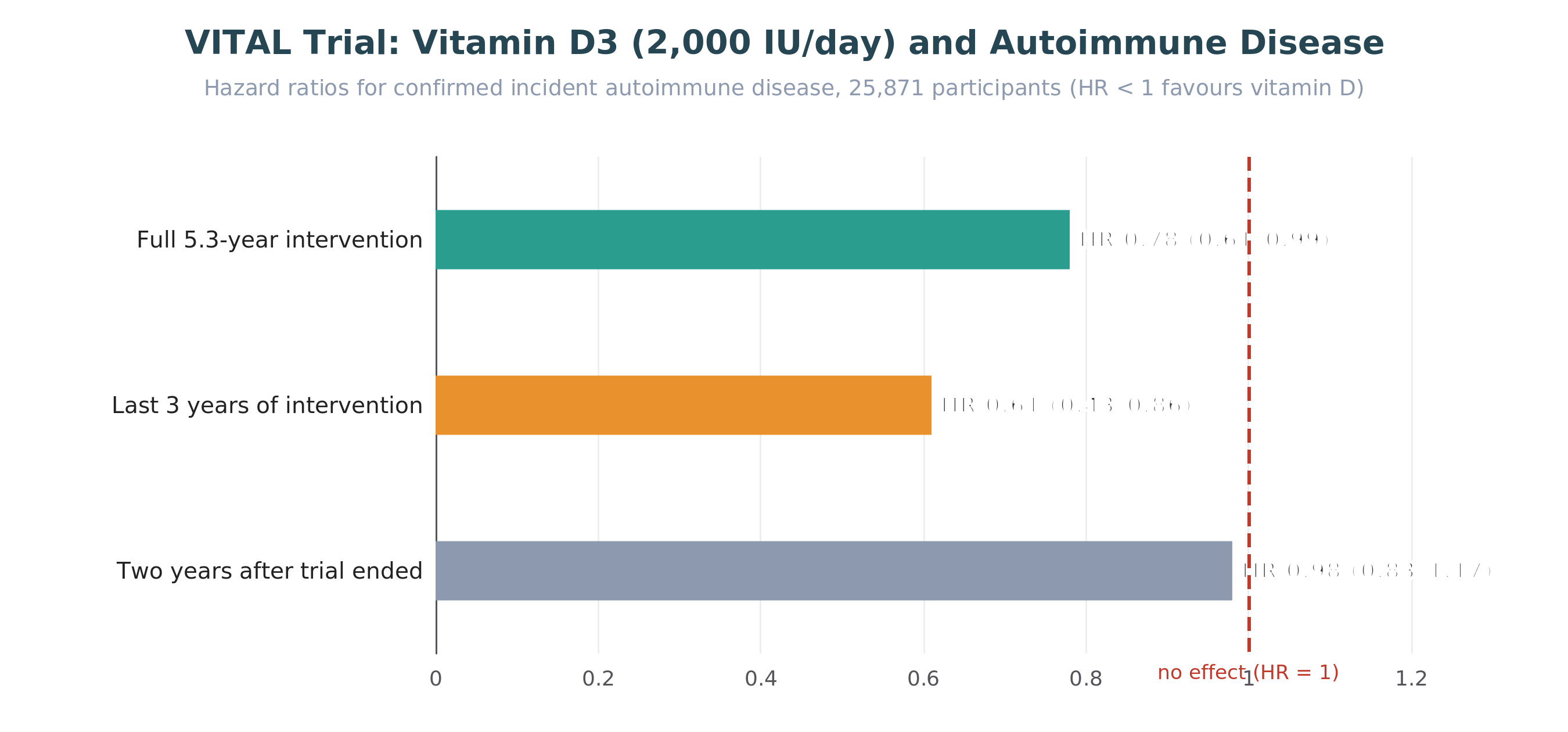
But the same trial found the supplement arm developed 22% fewer confirmed autoimmune diseases than placebo (123 versus 155 cases, HR 0.78, 95% CI 0.61–0.99), and restricting the analysis to the final three years pushed that to a 39% reduction (HR 0.61, p = 0.005) — consistent with slow-moving pathology that needs sustained exposurePubMed. This is one of the few Grade A randomised results in the whole field.
And a detail that matters for the pill-versus-sun question: when participants were followed for two more years after the trial stopped, the protection dissipated (HR 0.98)PubMed. Vitamin D acts while the exposure continues — much like the sunlight behaviour it's standing in for — rather than conferring lasting immunity.
Why pill trials keep underselling sunlight
- Baseline repletion. Modern mega-trials enroll generally well-nourished volunteers, and in VITAL even the placebo arm could take up to 800 IU/day from outside sources. That tests "a little more versus enough" rather than "enough versus deficient", diluting any effect toward null.
- The free-hormone problem. Trials titrate total 25(OH)D, but tissues respond to the free and bioavailable fractions, which are shaped by vitamin D binding protein concentration and genotype — so identical blood targets deliver unequal cellular dosesPMC.
- They isolate one variable by design. Which is exactly the right thing to do for a drug trial — and exactly why it can't tell you what sunlight does.
What sunlight does that a capsule cannot
- Nitric oxide and blood pressure. UVA releases nitric oxide from stores in the skin, measurably lowering blood pressure — and this pathway is independent of vitamin D entirelyPubMed.
- Immune tolerance. UV exposure induces regulatory T cells and systemic immune tolerance, through a mechanism distinct from taking vitamin D orallyPubMed.
- Red and near-infrared light. More than half of sunlight's energy sits in this band, and it acts directly on mitochondria through cytochrome c oxidase — nothing in a capsule reaches that pathway.
- Your body clock. Daylight through the eyes sets circadian timing, which a supplement cannot touch at all. See morning sunlight and sleep.
One more asymmetry worth knowing: sunlight-derived vitamin D cannot reach toxic levels, because synthesis self-limits at photochemical equilibrium. Documented toxicity cases come from supplements, not from sunLinus Pauling Institute. That's an argument about toxicity only — sun exposure still carries burn and skin-cancer risk, and more is not better.
So when is a supplement the right answer?
Often — and without apology. A supplement is the honest workaround whenever the UVB simply isn't there:
- Through the vitamin D winter at higher latitudes, when midday sun produces little or nothing.
- If you're mostly indoors, or covered, or behind glass — UVB doesn't pass window glass.
- If you have darker skin at high latitude, are older, or otherwise synthesise slowly.
The sensible framing isn't pill versus sun. It's: use daylight when it's actually available, supplement the blood level when it isn't, and don't expect either one to do the other's job. Dose belongs with a clinician and a blood test — past repletion, more is not better.
The full evidence, with a grade on every claim, is in §9 of our review.